Why Glute Bridges Stop Working After the First Few Months (and What to Do Instead)
Quick Answer: Glute bridges stop burning after a few months because the exercise stopped being hard, not because your glutes stopped needing work. Bodyweight bridges have a low ceiling, and most people never add load or change leverage. Fix it with single-leg variants, hip thrusts, bands, or actual weight — not more reps.
Month one, glute bridges left you genuinely sore. Month four, you do three sets of 20 and feel roughly the same as when you started.
The obvious read is that your glutes have adapted and there’s nothing left to gain. That’s the wrong conclusion from the right observation.

Why Do Glute Bridges Stop Burning After a Few Months?
Because the burn was never a measure of your glutes’ need for training. It was a measure of the exercise’s difficulty relative to your current capacity.
Early on, a bodyweight bridge is a genuine challenge — the movement is unfamiliar, the muscle isn’t well recruited yet, and the load is meaningful relative to where you started. All three of those change fast.
Your glutes got stronger. The exercise didn’t. That’s the entire mechanism. A bodyweight bridge loads you with a fixed fraction of your own hips, and that number doesn’t grow. So the same movement that was 90% of your capacity becomes 40%, and 40% doesn’t produce much of anything.
The fading feedback is a success signal being misread as a failure signal.
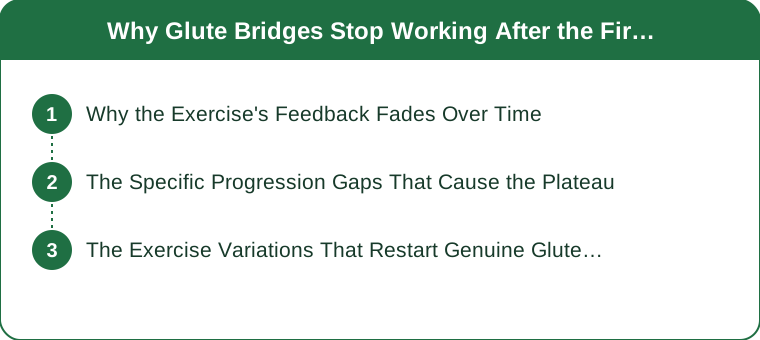
What Progression Gaps Actually Cause the Plateau?
Three specific gaps, and most people have all three at once.
1. No added load, ever. People progress a bench press by adding plates and progress a bridge by adding reps. But reps past roughly 20 shift the exercise toward endurance rather than strength, so you’re training a different quality and wondering why the strength quality stalled.
2. Leverage never changes. A two-leg bridge splits the work. A single-leg version roughly doubles the demand on each side instantly — a real progression that costs nothing. Most routines never take that step.
3. Range and position stay identical. Feet in the same spot, same elevation, same tempo, for months. Elevating your shoulders or your feet changes where in the range the hardest part sits, which changes the training stimulus meaningfully.
And a quieter fourth: as you get better at the movement, you also get more efficient at it. Better coordination means less wasted effort, which means less felt burn even at identical load. Efficiency feels like nothing happening.

5 Mistakes Everyone Makes When Bridges Stop Working
- Adding reps instead of load. Sets of 40 don’t rebuild a strength stimulus. They rebuild your patience.
- Assuming a “glute activation” problem. If bridges worked for two months, activation isn’t the issue. Load is.
- Abandoning the movement pattern entirely. The hip hinge/extension pattern is still valuable — it’s the version that’s too easy, not the pattern.
- Adding a band and calling it progressed. A light band around the knees changes abduction demand, not extension load. Useful, but not the progression you needed.
- Chasing the burn as the goal. The third mistake surprises even people who lift regularly, but this is the one that keeps them stuck: burn is a sensation, not a measure of adaptation.
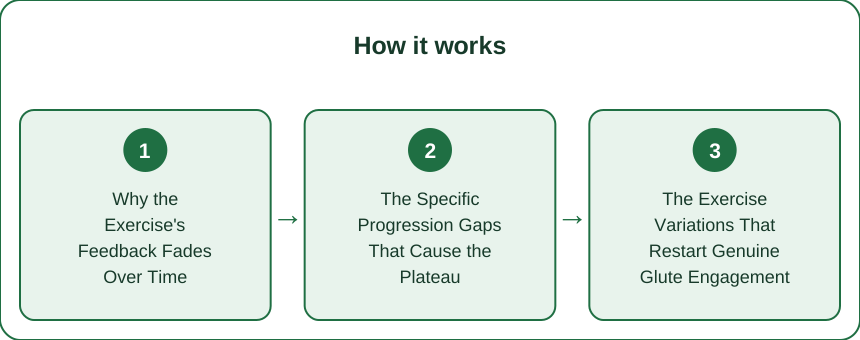
What Should You Progress To Instead?
Pick one, run it for 4–6 weeks, then progress that:
Single-leg glute bridge. Free, immediate, and roughly doubles the per-side demand. Start with 8–10 controlled reps per side. If your hips rotate toward the working side, drop reps until they don’t.
Weighted hip thrust. Shoulders on a bench, barbell or dumbbell across the hips. This is the direct heavy-loadable version of the same pattern, and it has real room to grow — 3 sets of 8 with a load you could manage 10 of is a sensible starting point.
Feet-elevated or shoulder-elevated bridges. Changes the leverage and the hardest point in the range without needing equipment.
Tempo and pauses. A 2-second pause at full extension with a 3-second lower turns an easy set into a much less easy one. It’s the cheapest progression on this list.
Load with anything you have. A dumbbell, a loaded backpack, a kettlebell across the hips. The point is that the number goes up over time.
One comfort note that matters more than it sounds: hip thrusts and bridges put a bar or weight directly across your hips and involve a lot of floor contact. Gear that stays put through the movement — squat-proof high waist leggings rather than anything that rolls at the waist — removes a genuine distraction from a set where you want to be thinking about your hips, not your waistband.
When to see a professional: if bridges produce lower-back pain rather than glute fatigue, or if one side is markedly weaker in a way that isn’t improving, that’s worth a physical therapist’s eye before you add load. This is general information, not medical advice.
FAQ
How often should I train glute bridges or hip thrusts?
Two to three sessions a week is a common and workable frequency, with at least a day between hard sessions. More matters less than whether the load is actually progressing.
Should I still do bodyweight bridges as a warm-up?
Yes — they’re genuinely useful for warming the pattern before heavier work. Just stop counting them as your strength training.
How do I know if I’m progressing?
Track load and reps, not sensation. If the number you can handle for a given rep range is higher than it was a month ago, it’s working, regardless of how much it burns.
TL;DR
- The burn faded because the exercise got easy, not because your glutes stopped needing training.
- Bodyweight bridges have a fixed ceiling — the load can’t grow with you.
- Three progression gaps: no added load, unchanged leverage, unchanged range and tempo.
- Progress to single-leg bridges, weighted hip thrusts, elevated variations, or tempo work — and track load, not burn.
See It in Motion
Seen here: High Waist Yoga Leggings with Inner Pocket — shop it on bubblelime.com
Keep Reading
This article is for general informational and styling purposes only. Fit, sizing, and product availability may vary.