Why Your Glutes Work Better Later in the Session Than at the Start
Quick Answer: If your glutes only start working by the third or fourth set, the usual cause is that the first sets were being run by your quads and hamstrings while the glutes were slow to be recruited. Fixing it takes three things: a short low-load activation block before the main lift, a slower eccentric on the first two sets, and putting your best glute movement first in the session rather than last.
Set one feels like quads. Set two feels like hamstrings and lower back. Somewhere around set four your glutes finally turn up, do one excellent set, and then you are too tired to make use of it.
This is one of the most common complaints in lower-body training and it is almost always about sequencing rather than about the glutes themselves.

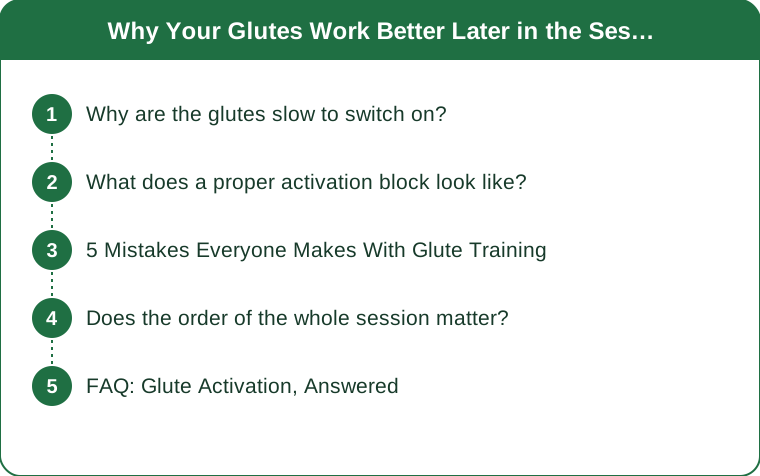
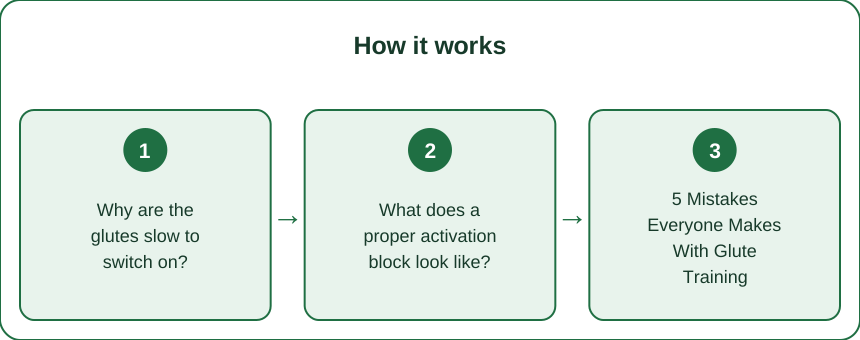
Why are the glutes slow to switch on?
Three reasons that compound, and none of them means the muscle is weak.
They have a large share of work available to be taken by other muscles. Hip extension can be driven by the glutes, the hamstrings and the adductor magnus, and in a squat or a thrust the nervous system will use whatever pattern it has practised most. If you have spent years mostly quad- and hamstring-dominant, that pattern runs by default on set one.
Prolonged sitting genuinely affects the pattern. Hours in a seated position keep the hip flexors shortened and the glutes lengthened and inactive. Reciprocal inhibition — where a contracted muscle reduces activation in its opposite — is part of why the first sets after a day at a desk feel disconnected. This is a temporary state, not a permanent one, which is exactly why it resolves by set four.
Glute max is a large muscle with a relatively high activation threshold. Recruitment follows size order, so bigger, more powerful motor units come in later as load and fatigue rise. Light early sets simply may not demand them.
Put together: your early sets are being done by whatever is already awake, and by set four fatigue in those muscles finally forces the glutes into the job. You are activating them through exhaustion of the alternatives, which is a slow and inefficient way to get there.
What does a proper activation block look like?
Short, light, and specific. Not a workout in itself.
Five to eight minutes, before the main lift. The goal is neural, not metabolic. If you are out of breath or burning, you have gone too hard and you will have less to give the actual session.
Three movements, two sets each, 10 to 15 reps:
Glute bridge with a two-second hold at the top. Bodyweight or very light. The hold is the important part — it forces a sustained contraction rather than a bounce.
Banded lateral walks or clamshells. These target the gluteus medius and the upper fibres of glute max, which are commonly the least active portion and the ones that stabilise the pelvis during your main lifts.
Single-leg hip extension of some kind — a B-stance bridge, a single-leg bridge, or a standing hip extension against a band. Unilateral work exposes and addresses side-to-side differences that bilateral lifts hide entirely.
Then go straight into your main lift. The effect of an activation block is short-lived, in the range of minutes rather than an hour. Doing it, then spending fifteen minutes on your phone, wastes it.
One caveat worth stating: activation work does not build much strength on its own. It is a preparation tool, not a training stimulus. The strength comes from the heavy work it enables.

5 Mistakes Everyone Makes With Glute Training
1. Putting the best glute movement last. Hip thrusts at the end of a session, after squats and lunges have already fatigued everything, means your most glute-specific lift gets your least available effort. Put the movement you most want to improve first, at least twice a month.
2. Going too heavy too early in the set count. If the load is heavy enough that your form breaks toward whatever pattern is easiest, you are reinforcing the pattern you are trying to change. The first two working sets should be slightly lighter with a deliberate three-second lowering phase, which forces the glutes to control the descent rather than dropping into it.
3. Training only in the sagittal plane. Squats, thrusts, deadlifts and lunges all work front-to-back. Glute medius and the upper glute max fibres need abduction and rotation — lateral band walks, cable abduction, side-lying work. Skipping these leaves a third of the muscle undertrained.
4. Chasing the burn instead of the load. Endless banded work produces a strong burning sensation and relatively little growth. Progressive load in the 6 to 12 rep range on hip thrusts, Romanian deadlifts and split squats is what actually builds the muscle. Bands are for activation, not for the main course.
5. Not addressing the desk. If you sit for eight hours, the single most effective thing outside the gym is standing and doing ten seconds of glute squeezes every hour. It sounds trivial. It measurably improves how the first sets feel.
Does the order of the whole session matter?
Considerably, and it is the easiest change to make.
Whatever comes first gets your best effort. This is true of neural freshness, of concentration, and of how much load you can handle with good positioning. If glutes are your priority, the session order should show it.
A reasonable glute-priority session: activation block, then hip thrust or a heavy bridge variation as your main lift, then a squat or split squat pattern, then a hinge, then accessory abduction work.
A reasonable general lower-body session that still serves the glutes: activation block, squat, hip thrust, hinge, accessory. Here the glutes are second, which is a fair compromise.
What does not work is glutes fifth, after everything else has taken the good sets.
Frequency matters too. Two to three lower-body sessions a week with glute work in each beats one large session, because you get more high-quality sets and more opportunities to practise the recruitment pattern. The pattern is a skill, and skills respond to frequency.
FAQ: Glute Activation, Answered
How long does an activation block stay effective?
The neural effect is short — think minutes, not hours. Do it immediately before your main lift, not at the start of a long warm-up followed by fifteen minutes of other things.
Should I feel my glutes burning during squats?
Not necessarily, and its absence does not mean they are not working. Squats load the glutes substantially in the bottom range, but the sensation is often felt in the quads. Judge by progressive load and by soreness distribution over time rather than by what burns during the set.
Is it normal for one side to activate better than the other?
Very common, and it is a good argument for including single-leg work. If the difference is large, persistent, or accompanied by pain, it is worth having it looked at by a physiotherapist. This is general information, not medical advice.
TL;DR:
- Early sets get run by quads and hamstrings until fatigue forces the glutes in — that is the whole phenomenon.
- Use a 5 to 8 minute activation block immediately before the main lift, then go straight in.
- Slow the eccentric on your first two working sets.
- Put your best glute movement first, train abduction as well as extension, and progress load rather than chasing burn.
Reorder one session this week and see whether set one feels different. It usually does immediately.
See It in Motion
Seen here: High Waist Embossed Yoga Leggings with Side Pockets — shop it on bubblelime.com
Keep Reading
This article is for general informational and styling purposes only. Fit, sizing, and product availability may vary.