Why Your Glutes Only Switch On by the Third Set
Quick Answer: Delayed glute sensation is usually not weakness — it is that the first set is spent finding the position rather than loading it. Motor recruitment, joint position sense and local blood flow all improve across sets, and the glutes rely on precise hip position more than most muscles do. The fix is not more activation drills; it is treating the first set as a positioning set with lighter load, and holding the position long enough for it to register.
Set one: nothing. You feel your quads, maybe your lower back, and a vague sense that you are doing this wrong.
Set three: unmistakable, exactly where it should be, and you have not changed the weight.
This is one of the most common experiences in glute training and it is almost always misread as an activation failure.

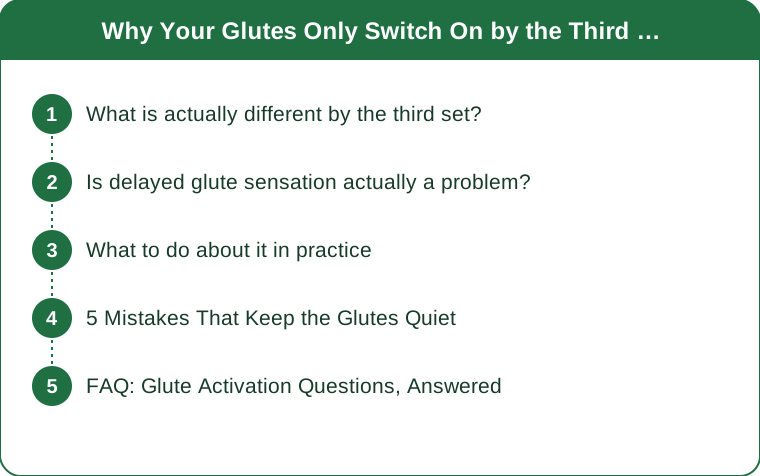
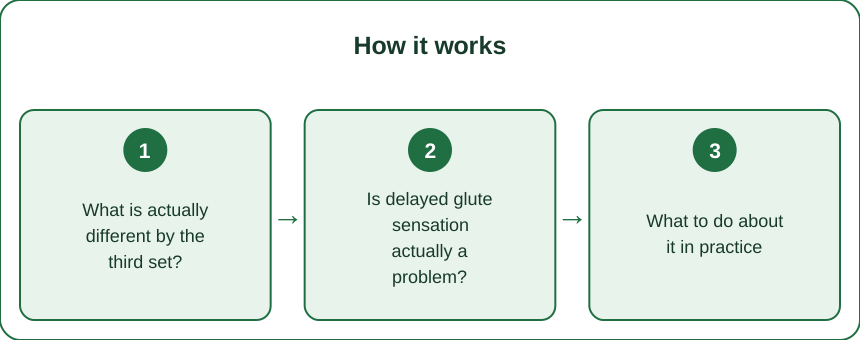
What is actually different by the third set?
Four things change, and none of them is your glutes becoming stronger in four minutes.
Motor unit recruitment sharpens. The nervous system’s coordination of a movement pattern improves with immediate repetition. On the first set your central nervous system is issuing a rough approximation of the pattern; by the third, the timing and the relative contribution of each muscle are considerably more refined. This is post-activation potentiation and short-term motor learning working together, and it is why the third set of almost anything feels more controlled than the first.
Joint position sense improves. Proprioceptors in the hip capsule and surrounding tissue give better feedback once the joint has moved through the range under load a few times. The glutes are unusually dependent on this because their mechanical advantage changes so much across the hip’s range — a few degrees of pelvic tilt is the difference between the glute being the prime mover and the hamstring or lower back taking over.
Local blood flow increases. More perfusion means more metabolite accumulation, and much of what you interpret as “feeling the muscle” is metabolite-driven sensation rather than force production. The muscle was working on set one; you just could not feel it yet.
And you settle into the position. On set one you are adjusting foot placement, bar position, ribcage, breath. By set three you are simply doing the movement. That alone accounts for a large share of the difference.
Is delayed glute sensation actually a problem?
Mostly no — but there are two versions and they need separating.
Normal version: you feel the glutes by set two or three, the sensation lands where you expect, and your loads progress over weeks. Nothing is wrong. This is what the first working set is for, and the correct response is to stop treating set one as a failure.
Worth addressing: you never feel the glutes in a given exercise regardless of set number, and something else consistently fatigues first. Lower back on hip thrusts, hamstrings on RDLs, quads on squats. That is a pattern problem rather than a warm-up problem, and it usually comes down to one of three things.
Range and position. The glute maximus is at its best mechanical advantage in the last thirty degrees or so of hip extension. If your hip thrust stops short of full lockout, or your squat depth or stance keeps the hip in a position where the quads dominate, the glutes are being asked to work where they are weakest. Most “I cannot feel my glutes” problems are actually “I never reach hip extension” problems.
Anterior pelvic tilt at the top. Extending through the lumbar spine rather than the hip is the single most common substitution, and it feels like a lower back exercise because it is one. Ribcage down, posterior pelvic tilt at lockout, and the sensation usually arrives immediately.
Tempo. A fast concentric with no pause at the top skips the exact position where the glute produces most tension. The pause is not a nicety — it is where the stimulus is.

What to do about it in practice
Restructure the session rather than adding another band walk.
Make the first set a positioning set. 50–60% of working load, deliberately slow, with a two-second pause at the top. You are not trying to fatigue anything; you are giving the nervous system the pattern. This is the single change that most reliably makes set two feel like set three used to.
Pause where the muscle is strongest. Two seconds at full hip extension on thrusts and bridges; two seconds at the bottom of an RDL with the hip fully loaded. A three-second pause at lockout on a light set does more for glute recruitment than any amount of pre-activation work.
Cut range that is not doing anything and add range that is. Elevating the shoulders properly on a hip thrust so the hip can reach true extension, or elevating the front foot on a split squat, buys you the productive part of the range.
Do the glute work first, or at least early. Recruitment is best when you are fresh and worst after your quads have already been fatigued by squats. If glutes are the priority this block, order the session accordingly.
Use unilateral work to expose asymmetry. A single-leg RDL or a B-stance hip thrust will tell you within one set whether one side is doing all the work — and if it is, that is worth knowing more than any amount of bilateral volume.
Then be patient with the load. The glutes respond well to load and range, and progression in either is what actually grows them. Sensation is feedback, not the goal.
5 Mistakes That Keep the Glutes Quiet
1. Treating activation drills as the fix. Fifteen minutes of clamshells and band walks before every session is fifteen minutes not spent on loaded hip extension. A brief primer is fine; a long one is a substitute for the training that would actually work.
2. Stopping short of lockout. The most common technical error in hip thrusts and bridges, and it removes the exact range where the glute has the most to offer. If you cannot reach full extension with the current load, the load is too heavy for the purpose.
3. Extending through the lower back instead of the hip. It gives the sensation of a finished rep without the hip having done the work, and it is why so many people report hip thrusts as a lower-back exercise. Ribs down, posterior tilt at the top.
4. Going straight to heavy on set one. The first set under a load you have not touched for a week is spent orienting. Load it as though that is what it is for and everything downstream improves.
5. Chasing the burn instead of the load. High-rep banded work produces plenty of sensation and comparatively little stimulus for growth. The third mistake on this list is the most common, but this fifth one is the reason people plateau for a year while still feeling the burn every session.
FAQ: Glute Activation Questions, Answered
Do I need glute activation exercises before every session?
No. A short primer — one light set of the main movement, plus perhaps one bridge variation — is enough for most people. Long activation circuits mainly displace productive work. The exception is if you have a specific reason, such as returning from injury.
Why do I feel hip thrusts in my quads?
Usually because your feet are too far forward, so the shin angle turns it into a partial leg press. Move your feet back until your shins are vertical at lockout, and check that you are reaching full hip extension rather than pushing through the knee.
Is soreness a sign it worked?
Not reliably. Soreness reflects unaccustomed load and eccentric stress more than effective stimulus, and it fades as you adapt to a movement even while that movement keeps producing results. Load progression over weeks is the honest measure.
Should I train glutes more often if I cannot feel them?
Frequency helps the skill of the movement, so two or three sessions a week is reasonable. But adding volume to a pattern that is substituting just gets you better at substituting — fix the position and the range first, then add frequency.
TL;DR:
- The first set is spent finding the position; recruitment, joint position sense and blood flow all improve across sets.
- Use set one deliberately as a light positioning set with a two-second pause at lockout — set two then feels like set three used to.
- Never feeling the glutes at all is a different problem: usually missing full hip extension, extending through the lower back, or no pause at the top.
- Load and range grow glutes. Sensation is feedback, not the target.
This is general information, not medical advice — persistent pain in the lower back or hip during these movements is worth a proper assessment.
See It in Motion
Seen here: High Waist Bootcut Yoga Pants with Side Pockets — shop it on bubblelime.com
Keep Reading
This article is for general informational and styling purposes only. Fit, sizing, and product availability may vary.