Why Your Glutes Feel Worked From Walking But Not From Training
Quick Answer: If a long walk fatigues your glutes and a structured session does not, the likely reasons are that the walk involved sustained hip extension under load over a long duration while your session used loads too light, ranges too short, or positions where stronger muscles take over. Hills and uneven ground in particular demand exactly the hip extension glutes exist for. It rarely means the glutes are not working in training - more often it means the stimulus is too small relative to what daily movement already provides.
Two hours on a hill and you feel it the next day.
Forty-five minutes of bridges, thrusts and kickbacks and nothing.
The walk is not magic. Your session is under-dosed.
This is general information, not medical advice.

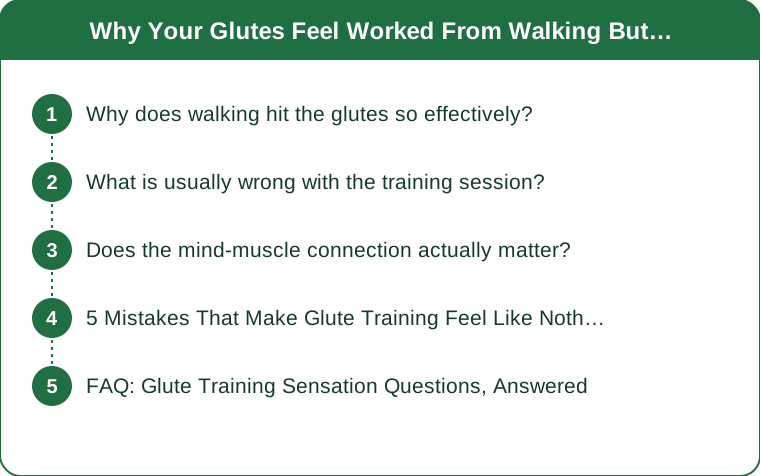
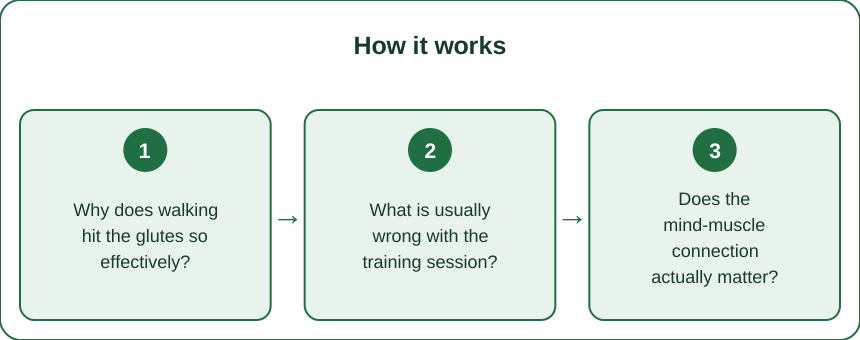
Why does walking hit the glutes so effectively?
Volume, duration and terrain - three things a typical glute session is short on.
The gluteus maximus is a hip extensor, and every step involves hip extension. A two-hour walk at a moderate pace is roughly 10,000 to 12,000 repetitions of a low-load hip extension. That is a volume no gym session comes close to.
Terrain multiplies the demand. Walking uphill increases glute activation substantially compared with flat ground, because the hip has to extend through a larger range against gravity. Uneven ground adds the gluteus medius, which works constantly to stabilise the pelvis on a single leg over variable surfaces.
And critically, walking loads the glutes in the position they are strongest and most used:
- Hip extension from a flexed position, which is the primary function
- Under body weight, which for most people is a meaningful load
- Repeatedly and continuously, with limited rest
- On one leg at a time, which recruits the stabilisers a two-legged bridge does not
The soreness you feel afterwards is not necessarily a sign of a better stimulus. Delayed onset muscle soreness correlates poorly with growth or strength adaptation - it tracks novelty and eccentric loading more than it tracks effectiveness. A long hilly walk is novel and eccentrically demanding, especially on the descent.
Which is the key reframe: the walk is not doing more for your glutes than your session. It is producing more soreness. Those are different measurements, and confusing them is how people conclude their training is failing when it is not.
That said, if you genuinely feel nothing during the session - not just afterwards - that is worth looking at.
What is usually wrong with the training session?
Load, range or position - and load is the most common by a distance.
Load first. The gluteus maximus is one of the largest and strongest muscles in the body. If a long walk under body weight fatigues it, then a set of bodyweight bridges is well below the threshold that produces any real stimulus.
Rough guidance on where loads should be:
- Hip thrusts: many trained women work in the range of body weight or above on the bar for sets of 8 to 12
- Bridges: if you can do 20 without difficulty, they are a warm-up, not a working set
- Kickbacks and band work: genuinely useful for activation and near-useless as a primary strength stimulus
- The real test: the last two reps of a working set should be genuinely hard
Range is the second issue. A partial hip thrust that stops short of full lockout misses the position where the glute is most active. A squat to a shallow depth is quad-dominant almost by definition. Full range under control beats heavier partials for this muscle specifically.
Position is the third, and it explains the not feeling it complaint most directly. In several common exercises the hamstrings and lower back are entirely capable of doing the work:
- A bridge or thrust where you push through the toes shifts load to the hamstrings
- A thrust where the ribcage flares and the back arches transfers work to the spinal erectors
- A deadlift with limited hip range becomes a back exercise
The corrections are unglamorous: push through the heel, keep the ribs down and the chin tucked, and finish by squeezing the glute rather than by lifting the hips higher. A hip thrust ends when the hips are level with the shoulders and knees - going past that is lumbar extension, not glute contraction.
And session structure matters. Doing glute work at the end of a session, after squats and deadlifts, means training an already-fatigued muscle with whatever energy is left. Move it to the start for a training block and see whether the sensation changes.

Does the mind-muscle connection actually matter?
Somewhat, and less than the load - but it is genuinely useful for this muscle.
There is reasonable evidence that deliberately focusing on a working muscle increases its activation, particularly at moderate loads and particularly for muscles people struggle to feel. The glutes are the standard example.
Why the glutes specifically: most people spend most of the day seated, with the hip in flexion and the glutes lengthened and inactive. The neural pattern for strong voluntary contraction genuinely gets less practice than it does for, say, the biceps.
What helps, in a sensible order:
- Warm up with something that isolates them. Two sets of banded bridges or clamshells before the main work - not as training, as a wake-up
- Slow the eccentric. Three seconds lowering on a thrust or bridge dramatically increases the sensation and the stimulus
- Pause at the top. A two-second squeeze at full extension is where the glute is shortest and most active
- Touch the muscle. Placing a hand on the glute during a set genuinely improves the ability to contract it consciously
- Reduce the load temporarily to relearn the pattern, then build back up
The caveat worth stating: focus is not a substitute for load. A perfectly felt set of bodyweight bridges will not build glutes. The sequence is to establish the connection at light load, then apply it to heavy work - not to choose one over the other.
On the single-leg point, which is where the walk comparison becomes most useful: walking is a single-leg activity and most glute training is not. Adding split squats, single-leg RDLs, step-ups and single-leg hip thrusts brings in the stabilising work that a walk provides and a bilateral session skips. For many people this is the missing piece.
5 Mistakes That Make Glute Training Feel Like Nothing
1. Using loads calibrated to how it feels rather than to what is hard. The glutes are among the strongest muscles you have, and a load that produces a burn is not the same as a load that produces adaptation. If you finish a set thinking you could do eight more, that was a warm-up.
2. Training them last, every session. Squats and deadlifts already fatigue the glutes, so isolation work at the end is done with what remains. Move glute work to the front for a block and the sensation usually changes immediately.
3. Cutting the range short at the top. The glute is most active at full hip extension, which is exactly the part people skip when the weight gets heavy. A shorter, heavier thrust is worse than a full, lighter one for this muscle.
4. Arching the lower back to finish the rep. The most common technical fault in hip thrusts. It looks like a bigger range and it is lumbar extension doing the work. Ribs down, chin tucked, stop when hips are level.
5. Doing everything on two legs. Walking is single-leg work, which is part of why it hits differently. A session of bilateral bridges and thrusts never asks the gluteus medius to stabilise a pelvis over one leg. Add split squats and single-leg RDLs.
A sixth that catches people out: using soreness as the measure of success. Soreness tracks novelty and eccentric load, not adaptation. Progressive overload tracked in a notebook is a far better signal than how you feel on Tuesday.
FAQ: Glute Training Sensation Questions, Answered
Does not feeling my glutes mean they are not working?
Not necessarily. Sensation and activation are related but not the same, and load, fatigue and technique all affect how much you notice. If you are progressively adding weight and reps over months, the muscle is being trained whether or not it burns.
Is walking better for glutes than lifting?
No, but it is high-volume, includes hills and uneven ground, and is entirely single-leg - which is why it produces more soreness. For strength and size, loaded training is far more efficient. The best answer is doing both.
How heavy should hip thrusts be?
Heavy enough that the last two reps of a set of 8 to 12 are genuinely difficult. Many trained women work at body weight or above on the bar. If you are doing sets of 20 without struggle, it is a warm-up rather than a working set.
Why do I feel it in my hamstrings instead?
Usually foot position and range. Pushing through the toes shifts load toward the hamstrings, and a foot placed too far from the hips does the same. Move the feet closer, push through the heel, and squeeze at the top rather than lifting higher.
Do activation exercises before training help?
Yes, as a warm-up rather than as training. Two sets of banded bridges or clamshells improves the ability to contract the muscle consciously during the heavy work that follows. They will not build anything on their own.
Should I add single-leg work?
If your session is all bilateral, yes - it is often the missing piece. Split squats, step-ups and single-leg RDLs recruit the gluteus medius for pelvic stability in a way two-legged exercises do not, which is much closer to what walking demands.
TL;DR:
- A two-hour walk is 10,000+ low-load hip extensions, plus hills and single-leg stability
- Soreness tracks novelty and eccentric load, not training effectiveness - the walk is not beating your session
- The usual training faults are load too light, range cut short at the top, and lumbar extension faking the finish
- Push through the heel, keep ribs down, stop when hips are level with shoulders and knees
- Train glutes first in the session for a block rather than last
- Use activation work as a warm-up and heavy work as the stimulus
- Add single-leg work - split squats, step-ups, single-leg RDLs - to match what walking demands
If the last two reps are not hard, it was a warm-up.
See It in Motion
Seen here: High Waist Bootcut Yoga Pants — shop it on bubblelime.com
Keep Reading
This article is for general informational and styling purposes only. Fit, sizing, and product availability may vary.