Why Your Glute Work Feels Different Once You Are Training Indoors Again
Quick Answer: Glute work feels harder and less connected in autumn because summer’s incidental activity — walking, hills, uneven ground — was doing a lot of low-level glute work that indoor life removes. Sitting more also shortens hip flexors, which reciprocally inhibits glute activation. The fix is more hip extension mobility before training and more single-leg work within it, not more volume.
The muscle did not weaken in three weeks. Its daily context changed.

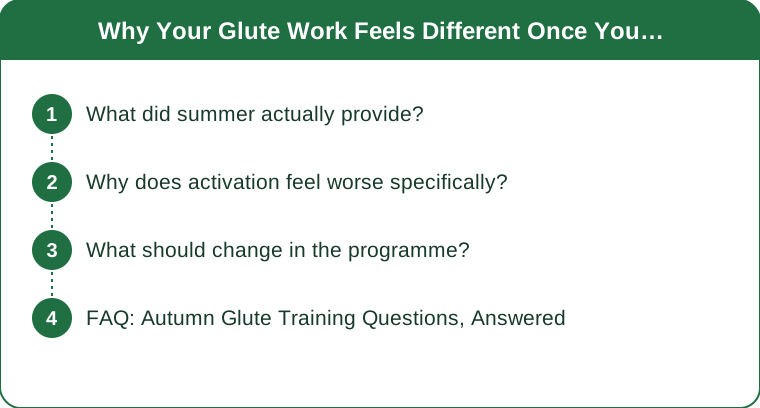
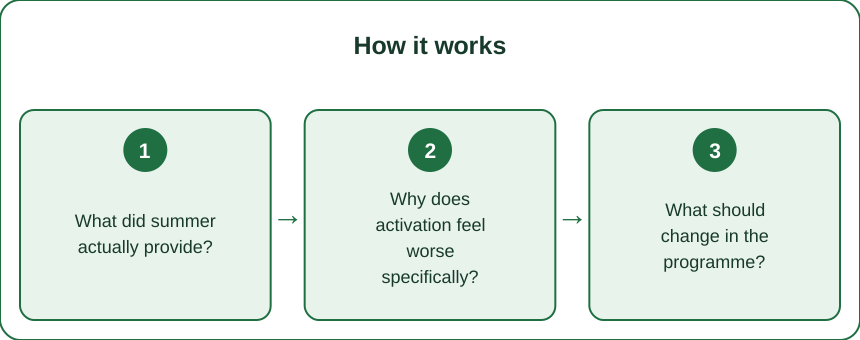
What did summer actually provide?
Volume without training. A summer of walking, hiking, beach sessions, and outdoor activity delivers thousands of low-load hip extension repetitions a week. That is real stimulus, and it disappears when the evenings do.
Uneven ground trains the frontal plane. Grass, sand, trails, and hills all load gluteus medius through side-to-side stabilisation constantly. A flat gym floor does not. This is why hip stability often feels worse in autumn even when strength numbers are unchanged.
Hills are the biggest loss. Uphill walking is one of the most effective glute maximus stimuli available and it is entirely incidental — nobody counts it as training.
Sitting time rises sharply. Autumn schedules mean more desk time and more evenings indoors. Prolonged hip flexion shortens the hip flexors, and a tight hip flexor reciprocally reduces glute activation through a normal neurological mechanism.
The net result: the same programme, performed by a body that is doing much less hip extension for the other twenty-three hours.
Why does activation feel worse specifically?
Reciprocal inhibition is the main mechanism. When the hip flexor on the front of the hip is shortened and tonic, the nervous system reduces drive to its antagonist — the glute. This is normal function, not dysfunction, and it reverses with mobility work.
Position matters more than effort. An anterior pelvic tilt, which sitting encourages, places the glute at a mechanical disadvantage. In that position, the hamstrings and lower back take over the movement, which is exactly the pattern people describe as ‘not feeling it in the glutes’.
Warm-ups get shorter indoors. In summer, you walked to the session. In autumn, you drive or take the lift and start cold.
Range of motion narrows. Cool tissue and less daily movement means the actual range being trained shrinks, and glute maximus does its most work at end-range hip extension — the exact range that gets lost first.

What should change in the programme?
Add ninety seconds of hip flexor work before glute training. A half-kneeling hip flexor stretch with a posterior pelvic tilt, 45 seconds a side, immediately before the session. This is the single highest-return change and it addresses the actual mechanism.
Add single-leg work, not more volume. Split squats, step-ups, single-leg RDLs, and lateral step-downs replace what uneven ground was providing. Two exercises a session is enough.
Train the abduction that hills and trails used to cover. Banded lateral walks, side-lying abduction, or a cable abduction. Gluteus medius is the muscle that loses the most when the terrain flattens.
Prioritise range over load in the transition weeks. A hip thrust through full range at a moderate load beats a heavier partial. End-range hip extension is the point of the exercise.
Keep the walking. Twenty minutes of brisk walking a day, ideally with some incline, replaces a meaningful portion of what summer provided and supports everything else in the programme.
And expect two to three weeks. Activation quality returns fairly quickly once mobility and daily movement are addressed — considerably faster than actual strength would take to rebuild, which is a good sign that it was never strength that changed.
FAQ: Autumn Glute Training Questions, Answered
Do I need glute activation exercises before every session?
A short hip flexor stretch and one or two low-load activation movements before lower-body training is worthwhile, particularly after a day of sitting. It does not need to be a fifteen-minute routine.
Why do my hamstrings take over on hip thrusts?
Usually foot position and pelvic position. Feet too far forward shifts load to hamstrings; a rib flare and anterior tilt does the same. Tuck the pelvis slightly at the top and bring the feet back until the shin is vertical at lockout.
Is soreness a good indicator of glute work?
A poor one. Soreness tracks novelty and eccentric load more than effectiveness. Progressive load over weeks is the indicator that matters.
Should I train glutes more often in autumn to compensate?
Two to three dedicated sessions a week is plenty. What is missing is daily low-level movement, and that is better replaced with walking than with a fourth gym session.
TL;DR:
- Summer supplied thousands of incidental hip extension reps and constant frontal-plane work; autumn removes both.
- More sitting shortens hip flexors, which reduces glute drive through normal reciprocal inhibition.
- Add 90 seconds of hip flexor mobility immediately before glute training — highest return per minute available.
- Replace uneven terrain with single-leg and abduction work rather than adding volume.
- Keep twenty minutes of daily walking, ideally with incline, and expect activation to normalise in two to three weeks.
Nothing was lost. The background work stopped, and it needs putting back deliberately.
See It in Motion
Seen here: High Waist Bootcut Yoga Pants with Pockets — shop it on bubblelime.com
Keep Reading
This article is for general informational and styling purposes only. Fit, sizing, and product availability may vary.