Why Your Glute Training Stalls at the End of a Training Block
Quick Answer: A glute plateau at six to eight weeks is the most predictable event in a training block, and it is usually not about the glutes at all. Fatigue accumulates faster than it dissipates, so by week seven you are training on a deficit that masks real strength. The stabilizers give out before the prime movers - lower back, hamstrings and adductors are the usual limiters on a stalled hip thrust. And the movement has become efficient, meaning the same load produces less stimulus than it did in week two. The fix is a planned deload plus a change in stimulus, not more volume.
You added weight every week for six weeks. Week seven you matched. Week eight you missed a set you hit two weeks ago, and the last rep of every set is going up like it weighs twice what it does.
This is not a sign that the program stopped working. It is a sign the program worked and has now run its course, which is a different problem with a different solution.

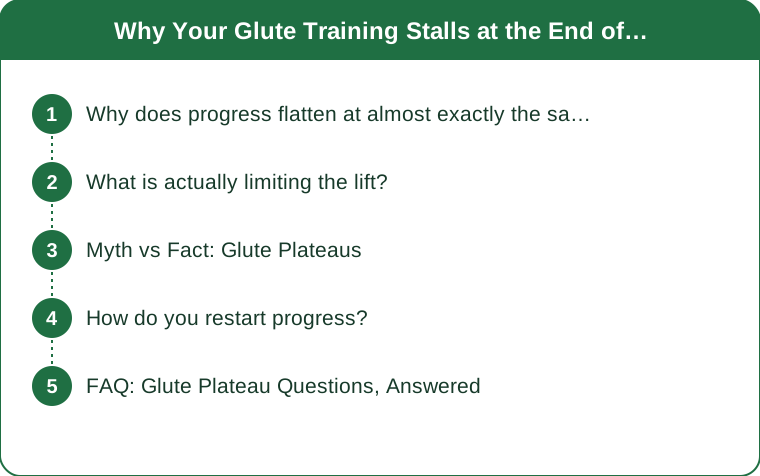
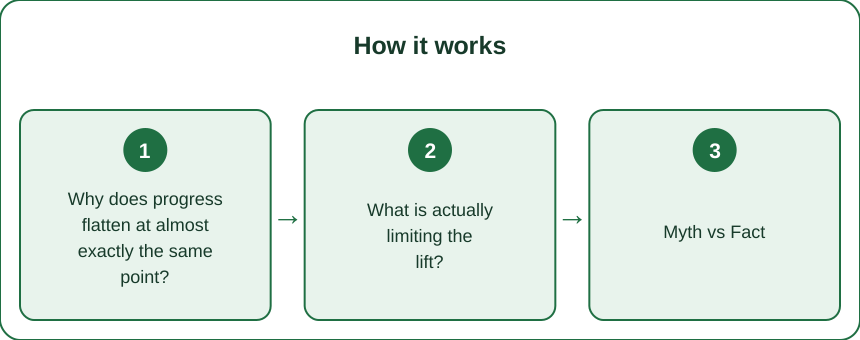
Why does progress flatten at almost exactly the same point?
Because fatigue accumulates on a longer timeline than fitness does.
Every hard session produces two effects: an increase in capacity that builds slowly and lasts, and fatigue that builds faster and clears slower than most people assume. Early in a block, the capacity gains outrun the fatigue and every week feels better. Around week six to eight the accumulated fatigue catches up, and your displayed performance flattens even though your underlying capacity is still rising.
This is why a deload so often produces a personal record in the following week. The strength was already there and fatigue was hiding it.
Glute training makes this worse than most for a specific reason. Hip thrusts and heavy bridges load the same tissue that squats and deadlifts load, and most programs run all three. Systemic fatigue from a heavy lower body program lands disproportionately on the hip extensors, so they are the first thing to show the accumulation.
The practical markers, in order of usefulness: the warm-up sets feel heavier than they should, sleep quality drops, motivation for the session specifically drops while general mood is fine, and resting heart rate creeps up a few beats. Any two of those in the same week during a stalled block is a strong signal to deload rather than push.
What is actually limiting the lift?
Almost always something other than the glutes.
On a stalled hip thrust, work through this list before adding anything to the program:
The lower back. If you feel the set in your lumbar spine, you are extending the spine rather than the hips at the top. The rib cage should stay down and the movement should end with a posterior pelvic tilt, not an arch. This is the single most common cause of a hip thrust that stops progressing, because spinal extension is a much weaker way to move the bar and it caps the load.
The hamstrings. Cramping or dominant hamstring feeling means the feet are too far out. Bring the heels closer until the shins are vertical at the top of the movement. Feet too far away shifts the work to the hamstrings; feet too close shifts it to the quads.
The adductors. Knee collapse under load means the adductors are winning the argument. Actively push the knees out through the whole range, or use a light band above the knees as a cue.
Breathing and bracing. A set of eight heavy thrusts on one held breath fails on breath, not on strength. Breathe at the bottom of each rep, brace, and drive.
Fixing the limiter often restores progression without changing the program at all.

Myth vs Fact: Glute Plateaus
Myth: A plateau means you need more volume. Fact: By week seven of a block, more volume usually adds fatigue faster than stimulus. If you are already at a reasonable number of hard sets per week, adding more is the intervention least likely to work and most likely to require a longer recovery later.
Myth: Heavier is always more glute stimulus. Fact: Past a point, added load is taken by compensations - spinal extension, reduced range, hamstring dominance. A lighter load with a full range and a genuine pause at lockout frequently produces more glute tension than a heavier one with a shortened range.
Myth: Soreness tells you it worked. Fact: Soreness tracks novelty and eccentric loading much more than it tracks growth stimulus. A movement you have done for eight weeks will stop making you sore long before it stops working, and chasing soreness is what leads people to change programs too often.
Myth: The glutes need to be trained differently from other muscles. Fact: They respond to the same principles as any other muscle - progressive overload, adequate volume, sufficient recovery. The one genuine difference is that the hip extensors are heavily involved in nearly every lower body movement, so their recovery budget is spent by more of your program than you might account for.
How do you restart progress?
Deload first, then change the stimulus - in that order.
The deload. One week, same movements, roughly half the volume at about 80 percent of the working weight. Not time off, and not a light week where you secretly do the same work. The point is to let fatigue clear while keeping the movement pattern. Most people come back stronger in week two than their best week of the block.
Then change one variable, not all of them.
Rep range. If you spent the block at 8 to 10, run the next at 5 to 6 or at 15 to 20. Both are effective, and the change itself is much of the stimulus.
Tempo or pause. A two-second pause at lockout on every rep is a dramatically different stimulus at a lower load, and it exposes any range-of-motion compensation immediately.
Movement variation. Swap the barbell hip thrust for a single-leg version, a B-stance version, or a deficit setup. Single-leg work is particularly useful after a plateau because it reveals a side-to-side difference that the bilateral version was hiding - and that asymmetry is often the actual reason the bilateral lift stopped moving.
Frequency. Two sessions of moderate volume usually beat one of high volume for the hip extensors, because the recovery is spread.
Change one. Run it six to eight weeks. Expect the same plateau at the end, and plan the deload before you hit it this time.
FAQ: Glute Plateau Questions, Answered
How long should a deload actually be?
A week is right for most people at most training ages. The signal that it worked is that your warm-up sets feel light again and you want to train, not that you feel fully rested - fatigue clearance is not the same as feeling fresh, and waiting to feel fresh usually means taking more time off than you needed.
Should I keep training glutes during the deload?
Yes. Detraining is not the concern over one week, but keeping the movement pattern is valuable and the reduced load still gives you the technical practice. Half the sets, slightly lighter, same movements.
Is it a plateau if I stopped getting sore but I am still adding weight?
No - that is adaptation working exactly as intended. Soreness fades as the movement becomes familiar while the training effect continues. The plateau is when the load stops moving, not when the soreness stops.
TL;DR:
- Six to eight weeks is when accumulated fatigue catches up - the strength is there and fatigue is hiding it.
- The limiter is usually not the glutes: check for spinal extension at lockout, foot position, knee collapse and breath-holding.
- A deload of half the volume at 80 percent for one week is the highest-return intervention available.
- Change one variable after the deload - rep range, tempo, movement or frequency - not all of them.
- Single-leg variations expose the asymmetry that was quietly capping the bilateral lift.
- Soreness is not the measure. Load moving over weeks is.
Plan the deload before you need it, and the plateau becomes a scheduled event rather than a discouraging surprise.
See It in Motion
Seen here: High Waist Bootcut Yoga Pants with Side Pockets — shop it on bubblelime.com
Keep Reading
This article is for general informational and styling purposes only. Fit, sizing, and product availability may vary.