Why Single-Leg Work Exposes What Both Legs Together Hide
Quick Answer: Bilateral exercises let the stronger side quietly take more of the load, and they also remove the frontal-plane stability demand that the gluteus medius exists to meet. Single-leg work strips both compensations away, which is why it feels disproportionately hard and why it exposes side-to-side differences a barbell hides. Most people find a gap of some size, and small asymmetries are normal - it is the large ones and the ones that come with pain that matter.
You squat well. Your numbers have been climbing all year. Then someone puts you in a split squat with no weight at all and by rep six the standing leg is shaking and the knee is wandering inward, and you find yourself wondering what exactly you have been training.

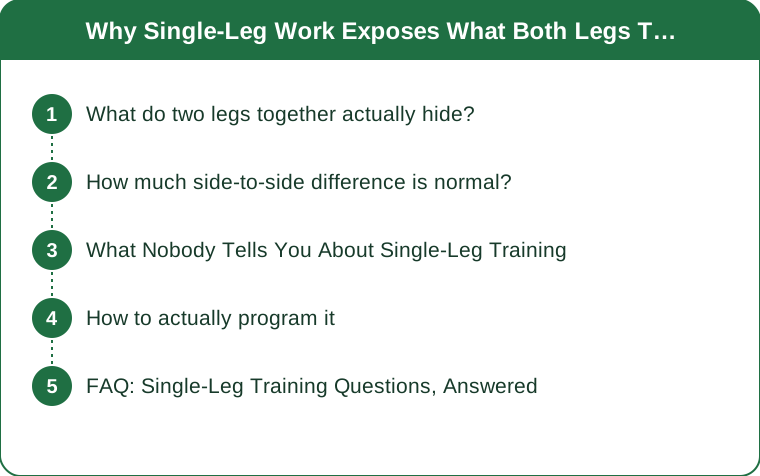
What do two legs together actually hide?
Two separate things, and they are worth separating.
The first is load sharing. In a bilateral squat or deadlift, the body will find a way to complete the lift, and if one side produces force more readily, it takes on more. Force-plate research on bilateral lifts shows that side-to-side load asymmetries are common and often invisible to the lifter, because the bar still moves evenly and nothing feels wrong.
The second is stability demand, and it is the bigger one for glutes. Standing on two feet gives a wide base of support, and the frontal-plane demand is minimal. Standing on one foot narrows that base dramatically, and now something has to prevent the pelvis dropping on the unsupported side - which is precisely the job of the gluteus medius and minimus. A bilateral squat can be performed well with an underworking gluteus medius; a single-leg squat cannot.
There is also a phenomenon called the bilateral deficit, where the force produced by two limbs together is often less than the sum of what each produces alone. It runs in the opposite direction from what most people assume and is one reason unilateral training carries genuine value rather than just being a variation.
And a coordination component. Single-leg tasks demand more from balance and proprioception, and those improve rapidly with practice. Some of the early difficulty is a skill deficit rather than a strength deficit, which is encouraging - it improves quickly.
What this means practically: the split squat that humbles you is not revealing that your squat was fake. It is revealing that your squat was measuring something different, and that something else has been quietly under-trained alongside it.
How much side-to-side difference is normal?
More than people expect, and less than the internet suggests is catastrophic.
Some asymmetry is universal. Almost everyone has a dominant side, shaped by handedness, sport history, occupational posture, and old injuries. A perfectly symmetrical body is not the baseline and is not the goal.
A commonly cited threshold in return-to-sport testing is around 10 percent - a limb symmetry index below roughly 90 percent is often treated as a flag in rehabilitation contexts. That threshold comes from injury rehabilitation research and is not a rule for healthy general trainees, but it is a reasonable rough marker of when a difference is worth deliberate attention.
How to test it simply. A single-leg sit-to-stand from a bench, counting quality reps on each side, is accessible and informative. A single-leg hip thrust to failure works well too. Do the weaker side first, and match the stronger side to it rather than pushing the stronger side further.
What matters more than the raw number: whether the difference is symptomatic. A ten percent gap with no pain and no movement quality problem is a training note. A gap with knee pain, hip pain, or a visible pelvic drop is worth having assessed.
And watch quality, not just quantity. Count only reps where the pelvis stays level, the knee tracks over the middle of the foot, and the movement is controlled in both directions. Six good reps is a better data point than eleven scrappy ones, and it makes the retest meaningful.
Retest every six to eight weeks, not weekly. Balance and coordination improve fast enough in the first few sessions that weekly testing mostly measures skill acquisition rather than strength change.
Persistent pain, a sudden change in strength on one side, or a pelvic drop that does not improve with training warrants assessment by a physiotherapist. This is general information, not medical advice.

What Nobody Tells You About Single-Leg Training
The stability limit arrives before the strength limit, and that is a real constraint. In a split squat, you often stop because balance fails, not because the glute is done. That means the exercise, on its own, under-loads the muscle you are targeting. Holding a support - a rack, a wall, one finger on a bench - is not cheating; it removes the balance ceiling so the glute can actually be trained near its limit.
Not all single-leg exercises train the same thing. A rear-foot-elevated split squat is heavily quad and glute max dominant. A single-leg deadlift emphasises the posterior chain and hip stability. A step-down and a lateral step-up emphasise frontal-plane control and gluteus medius. Picking one and calling it single-leg work leaves gaps.
The weaker side should set the volume. The standard approach is to train the weaker side first, note the reps it produces with good quality, and then match on the stronger side. Doing the reverse - stronger side first, weaker side chasing - preserves the gap indefinitely.
You will not fully close the gap, and that is fine. Asymmetry reduces with dedicated work but rarely disappears, because its causes are structural and historical as well as trainable. The goal is functional and symptom-free, not identical.
Balance improves much faster than strength does. Expect noticeable stability gains within two or three sessions and strength changes over weeks. If you judge progress in week one you will conclude, incorrectly, that the problem is fixed.
And the surprising one: single-leg work often improves bilateral numbers. By addressing the under-trained side and the stability component, the bilateral lift frequently gets better rather than being displaced. It is additive rather than a substitution.
How to actually program it
Simple structure, sustained long enough to matter.
Two sessions a week is enough. Single-leg work is fatiguing and time-consuming - every set is effectively two sets. Two focused sessions beats five half-attempts.
Pick two movements per session from different categories. One knee-dominant - split squat, rear-foot-elevated split squat, step-up. One hip-dominant or frontal-plane - single-leg deadlift, lateral step-down, single-leg hip thrust.
Sets and reps: three sets of six to ten per side, with genuine control. If ten is easy with good quality, add load rather than reps.
Use support deliberately. Start with light fingertip support on a rack or wall, and progress by reducing support before adding load. This sequencing keeps the target muscle as the limiting factor throughout.
Do the weaker side first, always, and match. This single rule does more to reduce asymmetry over a training block than any exercise selection choice.
Place it early in the session, not at the end. Stability work performed while fatigued trains sloppy movement patterns, and the whole value here is quality of control.
Give it eight to twelve weeks before judging. Strength adaptation takes time, and the meaningful change - a smaller gap, better control at the same load - shows up over a block rather than a fortnight.
And keep bilateral training in the programme. This is not an argument for replacing squats and hip thrusts. Heavy bilateral work builds maximal strength efficiently, and single-leg work addresses what it cannot see. Running both is the point.
One practical note on soreness: the first two weeks of dedicated single-leg work often produce more soreness than expected, particularly in the gluteus medius, which most people have never trained directly. That is normal, and it settles quickly.
FAQ: Single-Leg Training Questions, Answered
Why are single-leg exercises so much harder than squats?
Two reasons stack. Standing on one leg removes the wide base of support, so hip stabilisers - mainly gluteus medius - have to prevent the pelvis dropping, a demand that barely exists in a bilateral squat. And you can no longer share load with the stronger side, so the weaker side is exposed at its actual capacity.
How much strength difference between legs is normal?
Some difference is universal and expected. Rehabilitation testing often treats a gap of more than about 10 percent as worth attention, though that threshold comes from injury contexts rather than general training. What matters more is whether the difference comes with pain, a pelvic drop, or a knee that collapses inward.
Should I hold onto something during split squats?
Yes, if balance is limiting you before the muscle is. Light support removes the stability ceiling so you can load the glute properly, and you progress by reducing support before adding weight. Falling over at rep five trains balance, not strength.
Which leg should I train first?
The weaker one, then match the stronger one to whatever the weaker one produced with good form. Training the stronger side first and letting the weaker side chase preserves the asymmetry, which is exactly the thing you set out to change.
Will single-leg work make my squat weaker?
Generally the opposite. It addresses the under-trained side and the stability component that bilateral lifting does not challenge, and most people find their bilateral numbers improve. It is best treated as an addition to heavy bilateral work rather than a replacement for it.
TL;DR:
- Bilateral lifts hide load sharing and remove the frontal-plane demand gluteus medius exists to meet.
- Some side-to-side difference is universal; large gaps with pain or a pelvic drop are what matter.
- Hold support if balance fails before the muscle does - the point is loading the glute, not testing balance.
- Weaker side first, then match. This one rule does most of the work in closing a gap.
- Two sessions a week for eight to twelve weeks, alongside your bilateral training rather than instead of it.
The split squat is not telling you your squat was fake. It is telling you it was measuring something else.
See It in Motion
Seen here: High Waist Yoga Leggings with Side Pockets — shop it on bubblelime.com
Keep Reading
This article is for general informational and styling purposes only. Fit, sizing, and product availability may vary.