Step-Up Height Is the Only Variable That Matters for Glutes
Quick Answer: Step-up height determines hip flexion at the start, and hip flexion is what determines glute involvement. A box at knee height or below trains mostly quadriceps. A box that puts your working thigh at or slightly above parallel to the floor — roughly mid-thigh height for most people — is where glute demand peaks. Go higher than that and you start compensating by pushing off the back foot, which removes the training effect entirely.
Most gyms have a step at about 30cm because that is what the aerobics class used. For glutes, that box is doing very little.
Here is how to find the height that works, and how to stop cheating once you are on it.

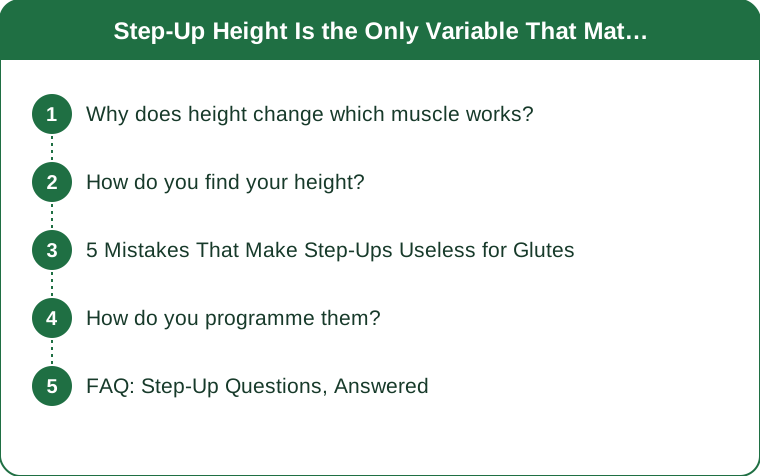
Why does height change which muscle works?
Because the deeper the hip is flexed at the start of the movement, the more the glute contributes to extending it.
Think about the two joints involved. Stepping up requires you to extend both the knee and the hip on the working leg. How much of each depends entirely on the angle you start from.
On a low step, the knee is bent but the hip is only mildly flexed. The bulk of the work is knee extension, which is quadriceps. You will feel it in the front of the thigh, because that is what is doing it.
On a step that puts your thigh parallel to the floor, the hip is flexed to around 90 degrees or more. Now hip extension is the dominant requirement, and the gluteus maximus is the primary hip extensor. Research on step-up variations consistently finds gluteal activation rising with box height, and the increase is substantial rather than marginal.
The hamstrings come along too, since they also extend the hip, which is why a high step-up is often felt across the whole back of the leg rather than in the glute alone.
Past parallel, the returns reverse. At a very high box, most people cannot generate enough force from the top leg alone, so they push off the trailing foot or lean the torso forward and use momentum. Both offload the working leg, and the exercise stops being a single-leg movement. This is why the highest box in the gym is not the best answer.
Torso angle interacts with all of it. A slight forward lean at the hip increases the hip flexion angle and shifts more work to the glutes even at a fixed box height, whereas a rigidly upright torso keeps it quad-dominant. This is a legitimate adjustment, not a form error, as long as the spine stays neutral and the lean comes from the hip.
How do you find your height?
Measure the angle, not the box. The box is only a proxy, and it is a bad one across different body types.
The test: put your foot on the step and look at your thigh. If the top of your thigh is roughly parallel to the floor, you are at the right height for glute emphasis. If it is clearly below parallel, the box is too low. If your knee is well above your hip and you cannot stand up without a hop from the back foot, it is too high.
This means the right box height varies enormously by leg length. A woman with long femurs might need 50cm to hit parallel where someone shorter needs 35cm. The standard gym step being wrong for you is not a fitness problem, it is a proportion problem.
Start lower than the target and earn the height. If you cannot do a controlled rep at parallel without pushing off, that is information — build there for a few weeks and raise the box when you can.
Use plates or a plyo box you can stack. Adjustability is the whole game here. A single fixed step means one fixed stimulus.
Check the descent, not just the ascent. Lowering under control from a parallel-height step is genuinely hard and is where most of the strength benefit and most of the soreness comes from. If you can go up but you drop down, the height is too high for your current control.
The knee-over-toe question is a non-issue here. The knee travelling forward over the toe on a step-up is normal and safe for healthy knees, and forcing an artificially vertical shin just shifts you back toward the low-box quad pattern.
Keep the box stable. A wobbling step or an unsecured plate stack turns a strength exercise into a balance exercise with a fall risk. This is worth being fussy about.

5 Mistakes That Make Step-Ups Useless for Glutes
1. Pushing off the bottom foot. The single most common error, and it invalidates the exercise. If your trailing foot is driving off the floor, that leg is doing the work and the top leg is along for the ride. Test it by resting the trailing foot on the toe only with almost no weight, or by starting each rep with the trailing foot already lifted slightly. If you cannot do the rep that way, reduce the height or the load.
2. Using momentum from the arms or torso. Swinging up and rocking forward gets you onto the box without your glute contributing much. Slow the tempo to a two-second ascent and the cheating becomes obvious immediately.
3. A box that is too low. Covered above, and worth repeating because it is so common. A 20cm step is a warm-up, not a glute exercise. If your gym only has low steps, stack plates or use a bench.
4. Going too heavy too soon. Load is not the primary variable for step-ups — height and control are. Heavy dumbbells on a low box gives you a loaded quad exercise. Moderate dumbbells at parallel gives you the glute stimulus you were after. Get the height right first, then add load.
5. Skipping the lowering phase. Stepping up carefully and then dropping off the box halves the exercise. The eccentric portion is where a large share of the strength and hypertrophy stimulus lives, and it is also what builds the control needed for stairs, hills and trail descents. Three seconds down, every rep.
How do you programme them?
As a primary single-leg movement, not as an afterthought at the end of the session.
Sets and reps: 3 to 4 sets of 6 to 10 per leg is a sensible working range for strength and size. Higher reps work fine too, but balance degrades as you fatigue, and a step-up done tired is a step-up done with a push from the back foot.
Place them early. Single-leg work demands balance and coordination, both of which decay after a heavy bilateral lift. Step-ups after a set of heavy squats will be limited by fatigue rather than by the glutes.
Progress in this order: height to parallel, then control on the descent, then load, then reps. Adding weight before the height is right locks in the quad-dominant version.
Load options change the feel. Dumbbells at the sides are simplest. A goblet position in front increases the forward lean slightly, which nudges more hip flexion and more glute. A barbell on the back allows the most load but demands the most balance, and is worth earning rather than starting with.
Pair them intelligently. Step-ups and hip thrusts complement each other well, because one loads the glute in a deeply flexed position and the other loads it in full extension — different parts of the same job. Step-ups plus squats is more redundant.
Two to three times a week is plenty for most people, with at least a day between sessions. Single-leg work is more fatiguing per set than it looks, and soreness in the glutes and hamstrings after the first few sessions at a new height is normal.
This is a good time of year to build them in. As outdoor running and hiking taper with the weather, the single-leg strength that trails and hills were maintaining starts to fade. Step-ups are the most direct indoor substitute, and they carry over almost exactly to stair climbing and hill descents when you go back out.
FAQ: Step-Up Questions, Answered
What height should I actually use?
Whatever puts your working thigh roughly parallel to the floor when your foot is on the box. For most people that is somewhere between mid-shin and mid-thigh depending on leg length — measure yourself rather than trusting a number.
Are step-ups better than lunges for glutes?
At the right height, step-ups typically produce more hip flexion at the start than a standard lunge, which favours the glute. Lunges have their own advantages for control and for the trailing leg. Both are worth having.
Why do I feel it in my quad instead of my glute?
Almost always the box is too low, or you are staying rigidly upright. Raise the box toward parallel and allow a slight forward lean from the hip.
Is it bad if my knee goes past my toes?
No. Knee travel over the toes is normal in a step-up and is well tolerated by healthy knees. Existing knee pain is a reason to reduce height and load and speak to a physiotherapist, not a reason to distort the movement.
Can I do these at home?
Yes, and stairs work well as long as the step is high enough — a single stair usually is not, but a sturdy chair, a low bench or a stacked step platform is. Stability matters more than anything else for home setups.
How do I know if I am pushing off the back foot?
Lift the trailing foot off the floor before you start the rep, or rest only the toe with no pressure. If the rep suddenly becomes impossible, you had been pushing off. Reduce the height and rebuild from there.
TL;DR:
- Height sets hip flexion, and hip flexion sets glute involvement. The box is the whole variable.
- Aim for the working thigh parallel to the floor. Lower is a quad exercise; much higher forces cheating.
- Do not push off the trailing foot. Lift the toe to prove it, and drop the height if the rep disappears.
- Progress height, then control, then load — adding weight first locks in the wrong pattern.
- Three seconds down on every rep. The descent is where most of the benefit is.
Stack plates until your thigh is level, then keep that height written down. It is the only setting you need to remember.
See It in Motion
Seen here: High Waist Embossed Yoga Leggings with Side Pockets — shop it on bubblelime.com
Keep Reading
This article is for general informational and styling purposes only. Fit, sizing, and product availability may vary.