The Hip Thrust at Home: Couch Edition Setup Guide
Quick Answer: You don’t need a gym bench. Set your shoulder blades on the edge of a firm sofa or a sturdy chair, plant your feet hip-width, and walk out until your shins are vertical at the top of the rep. Chin tucked, ribs down, squeeze for a one-count at the top. Progress bodyweight → 20 clean reps → single-leg → loaded with a backpack of books.
The hip thrust is the glute world’s darling — research-backed, easy on the spine, and brutally effective at the one job it does.
It also appears to require a gym bench, which is why most people who train at home never do it.
They’re wrong about that. Your couch has been moonlighting as hip thrust equipment since the day it arrived.
How Do You Set Up a Hip Thrust on a Couch?
The setup is 80% of the exercise. Get it wrong and you’ll feel it in your lower back all week.
Bench height matters most. You want the edge of the surface hitting you at the bottom of your shoulder blades — roughly 35–45 cm off the floor for most people. A standard sofa seat is usually about right; a dining chair is often a touch high but workable.
Firm beats soft. A marshmallow sofa lets your shoulders sink, which kills the stability and changes the whole movement. If yours is soft, lay a cushion board, a chopping board, or a folded firm cushion along the edge and put your shoulders on that.
Make sure it can’t slide. A sofa against a wall is ideal. A chair on a hard floor will travel away from you on the first hard rep — put it against a wall or on a rug.
Feet hip-width, then walk out until your shins are vertical at the top. This is the checkpoint people skip. If your feet are too close, your quads take over; too far and your hamstrings do. Vertical shins at lockout puts the work in the glutes, which is the entire point.
Move the coffee table. The living room is now a facility.
What Are the Form Checkpoints?
Four, and the first two prevent 90% of the back complaints.
Chin tucked — stare at your knees, not the ceiling. Ceiling-gazers extend the neck, which cascades into an arched lower back, and then they report that hip thrusts hurt their back. Keep your eyes on your knees throughout, so your gaze travels up and forward as you rise.
Ribs down. Think about pulling your bottom ribs toward your hips before you start the rep, and keep that. Ribs flaring up is the same arch problem from the other end.
Full hip extension without a back arch. The finish position is a straight line from knees to shoulders. If your hips seem to go higher than that, you’re arching your back, not extending your hips. The move is hips up, not back bend up.
Squeeze at the top for a one-count. Then lower with control. Bouncing off the floor at the bottom throws away most of the tension.
3 sets of 10–15 reps at a tempo of roughly one second up, one second hold, two seconds down.

How Do You Add Load Without a Barbell?
Progression never needed a barbell. It needed arithmetic.
Step 1 — Bodyweight to 20 clean reps. Clean means chin tucked, no back arch, full one-count squeeze. When 20 is genuinely easy, move on.
Step 2 — Single-leg hip thrust. One foot planted, the other leg extended straight or knee hugged to your chest. This roughly doubles the difficulty instantly and is free. Aim for 3 × 8 per side. Most people find a noticeable side-to-side difference here, which is useful information.
Step 3 — Add external load.
- A backpack full of books laid across the hips is the best home option — pack it flat and it distributes well.
- Water jugs or containers held on the hips. A 5-liter jug is 5 kg.
- A dumbbell or kettlebell if you own one. Fold a towel under it; the bar on a bare hip bone is genuinely unpleasant.
Step 4 — Extend any weight’s usefulness with pause reps (3 seconds at the top) and slow negatives (4 seconds down). A backpack of books plus a 3-second pause is a hard set for almost anyone.
Where Does It Fit in a Week?
Twice weekly, 3 sets of 10–15, on non-consecutive days.
Pair it with the rest of a decent glute day: glute bridges as a warm-up, lateral band walks for the side glutes, and step-ups or split squats for the single-leg strength. Twenty minutes, all of it doable in a living room.
The hip thrust is the heavy hitter of that session — it loads hip extension at the position where the glutes are strongest, which is exactly what a squat doesn’t do. The couch is an unlikely venue. The results are indifferent to the postal code.
One caveat worth stating: if you have existing lower back pain, a disc issue, or you’re pregnant or postpartum, get guidance from a physiotherapist before loading this. Hip thrusts are often recommended in those situations precisely because they’re spine-friendly — but the setup and load need to be right, and guessing isn’t the move.
Frequently Asked Questions
Are hip thrusts better than squats for glutes?
They’re complementary. Hip thrusts load the glutes hardest at full hip extension — the top of the range — while squats load them hardest in the stretched bottom position. Research suggests both stimuli matter for growth, so the best glute programs include a squat or lunge pattern and a thrust or bridge pattern rather than choosing between them.
Why do I feel hip thrusts in my quads or hamstrings?
Foot position, almost always. Feet too close to your body shifts work to the quads; feet too far away shifts it to the hamstrings. Walk your feet until your shins are vertical at the top of the rep and the sensation usually moves straight into the glutes. If it’s still hamstrings, try turning your toes out slightly.
How much weight should I use for hip thrusts?
Enough that the last two reps of a set of 12 are genuinely hard while your form stays clean. At home that’s often a backpack with 8–15 kg of books once single-leg work has become manageable. There’s no fixed number worth chasing — the standard is clean reps close to failure, not a figure on a plate.
TL;DR:
- Shoulder blades on the edge of a firm sofa or sturdy chair, roughly 35–45 cm high.
- Soft sofa? Lay a firm board or cushion along the edge. Make sure it can’t slide.
- Walk feet out until shins are vertical at the top — this is what puts the work in the glutes.
- Chin tucked, eyes on knees, ribs down, one-count squeeze at the top.
- Ladder: bodyweight to 20 reps → single-leg → backpack of books → pause reps and slow negatives.
- Twice weekly, 3 × 10–15, alongside bridges, lateral walks, and step-ups.
See It in Motion
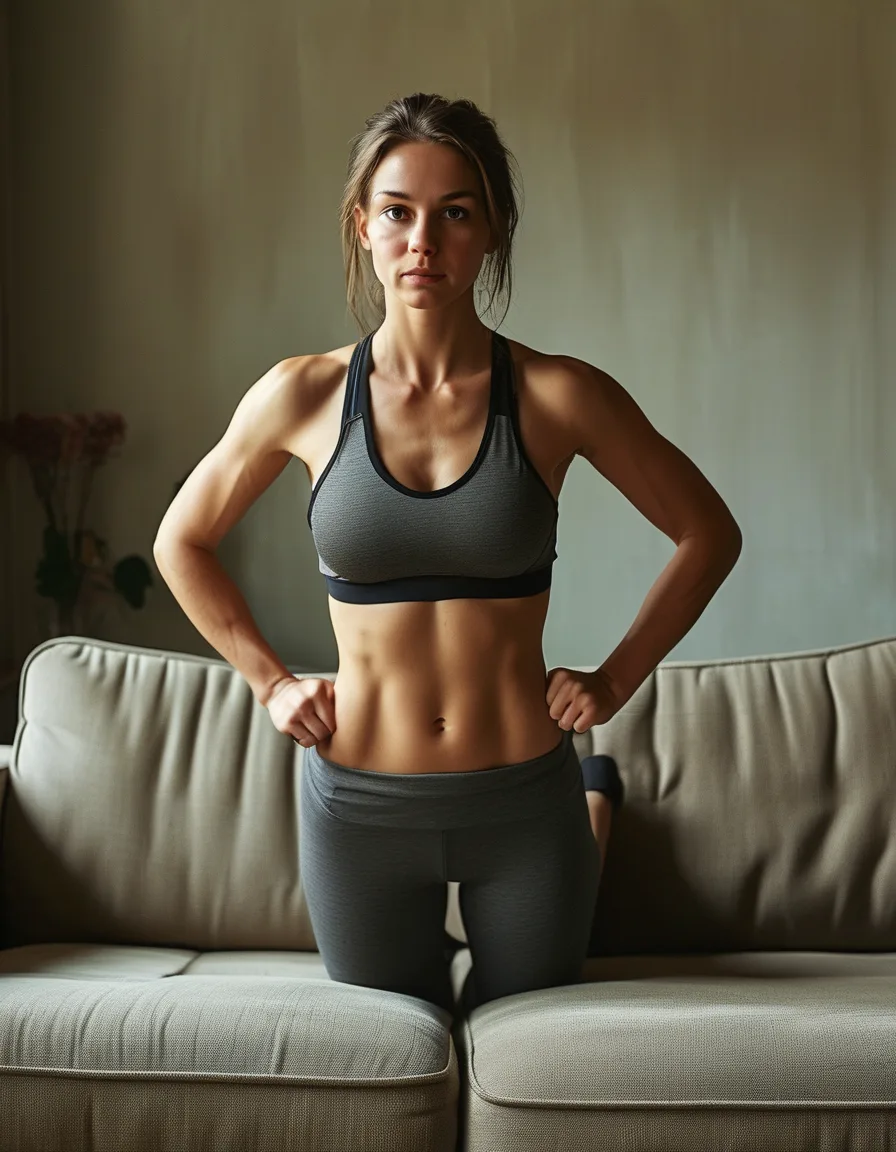
Seen here: Bootcut Capri Yoga Pants with Pockets — shop similar styles on bubblelime.com
Keep Reading
This article is for general informational and styling purposes only. Fit, sizing, and product availability may vary.