Why Your Glutes Feel Weaker After You Move Training Indoors
Quick Answer: Outdoor movement — hills, uneven ground, trails, sand — demands constant hip stabilization from the gluteus medius and minimus, which most indoor training barely touches. Moving indoors removes hours of low-level stabilizer work per week, and machine-based or bilateral gym work does not replace it. The fix is adding single-leg and lateral work, not adding more hip thrusts.
You trained outdoors all summer. You move indoors in October, keep lifting, and within a few weeks something feels off — less stable on one leg, a hip that aches after runs, glutes that feel like they went to sleep.
Your big lifts did not decline. Something else did.

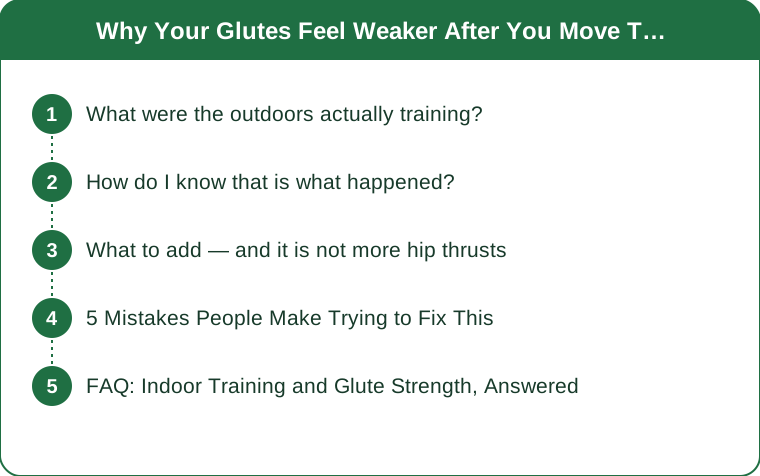
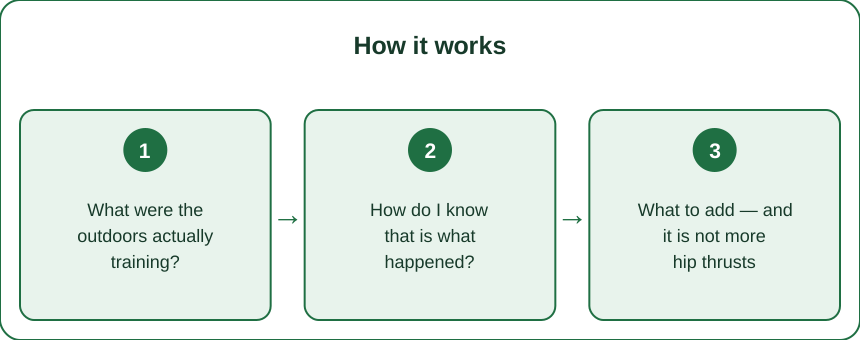
What were the outdoors actually training?
The stabilizers, continuously, at low intensity, for hours a week.
Uneven ground demands constant hip correction. Every step on a trail, a beach, or a grass field lands slightly differently, and the gluteus medius fires to control the pelvis on each one. This is not a workout in any structured sense — it is thousands of small corrections that accumulate into a genuine training stimulus.
Hills demand hip extension under load through range. Walking or running uphill is one of the most glute-dominant common activities, and there is nothing in a typical indoor routine that replicates it unless you deliberately use an incline.
Lateral movement happens constantly outdoors and almost never indoors. Stepping around obstacles, adjusting on a slope, changing direction on a trail — all frontal-plane work, and the frontal plane is where the gluteus medius lives.
Sand and soft ground multiply everything. Unstable surfaces dramatically increase stabilizer demand, which is why beach walking leaves people sore in places a treadmill never does.
Barefoot or minimal-shoe time contributes too. More foot and ankle work translates up the chain to more hip control.
What indoor training typically provides instead: bilateral, sagittal-plane, stable-surface work. A barbell hip thrust is an excellent glute maximus exercise and it trains almost none of what the trail was training. Machines are more stable still.
The result: your prime movers are fine, and the stabilizers that were getting hours a week of incidental work are getting close to zero.
How do I know that is what happened?
Four signs that point specifically to stabilizer loss rather than general strength loss.
1. Single-leg balance has degraded. Stand on one leg with your eyes closed. If this is noticeably harder than it was in August, and particularly if there is a clear difference between sides, that is hip stability rather than strength.
2. The pelvis drops on the single-leg stance. Have someone watch you from behind while you stand on one leg, or film it. A hip that drops on the unsupported side — a Trendelenburg pattern — is the classic gluteus medius signal.
3. Knee position collapses under fatigue. Knees drifting inward during the last reps of a squat, or during a step down, points to hip control rather than quad strength.
4. New aches in the outside of the hip, the IT band, or the knee. These are frequently downstream of poor hip control, and they tend to show up a few weeks into a change in movement pattern.
What it is not: if your loaded lifts have dropped substantially across the board, that is a general strength or recovery issue and it needs a different answer.
The quick test that catches most of this: a single-leg glute bridge, 10 reps each side, watching in a mirror. If one side shakes, drops, or cramps in the hamstring, that side is under-supported. The hamstring cramping specifically means the hamstring is compensating for the glute, which is the most common finding of all.

What to add — and it is not more hip thrusts
The principle: add instability, add single-leg, add the frontal plane. Volume on your existing bilateral work will not fix this.
1. Single-leg work, non-negotiable.
Bulgarian split squats — 3 sets of 8 per leg. Demanding, effective, and the closest gym equivalent to what hills were doing.
Step-ups to a box at knee height — 3 sets of 10 per leg, driving through the heel, controlled on the way down. The lowering is where the control is trained.
Single-leg Romanian deadlifts — 3 sets of 8 per leg. The most direct balance-plus-hip-hinge combination available.
2. Frontal plane work, which is what is genuinely missing.
Banded lateral walks — 3 sets of 15 steps each direction, band above the knees, staying low. Unglamorous, and among the most effective gluteus medius exercises available.
Side-lying hip abduction — 3 sets of 15 per side, slow, with the torso genuinely still.
Copenhagen plank or side plank with leg lift — for the adductor and abductor balance that trail walking maintained.
3. Incline work to replace hills.
Treadmill at 8–12% incline, walking, 15–20 minutes. This is the single closest substitute for hiking and it is dramatically underused. Hold the rails as little as possible — holding on removes most of the hip demand and turns it into a much easier exercise.
How to fit it in: the frontal plane work goes in the warm-up, where it doubles as activation. The single-leg work replaces one bilateral exercise rather than adding to the session. Two sessions a week is enough to reverse this within a month.
5 Mistakes People Make Trying to Fix This
1. Adding volume to the exercises they already do. More hip thrusts trains more of what is already working. The gap is in single-leg and lateral work, and adding sets of the wrong movement pattern does nothing for it.
2. Going too heavy on single-leg work immediately. Bulgarian split squats with heavy dumbbells when your balance has degraded means the balance limits the set before the muscle does. Start bodyweight, establish control, then load.
3. Rushing the tempo. Stabilizer work responds to control, not speed. A 3-second lowering phase on step-downs and split squats is where the adaptation is, and everyone rushes it.
4. Ignoring the weaker side. Almost everyone has an asymmetry, and training both sides identically preserves it. Start every single-leg exercise with the weaker side and match the stronger side to what the weaker one managed. This feels like leaving work on the table and it is the fastest way to even out.
5. Skipping the banded work because it feels too easy. Banded lateral walks look trivial and are genuinely effective for the gluteus medius specifically. The fourth mistake surprises people most — the exercises that feel least impressive are the ones that address this particular gap.
One more, on keeping the outdoor stimulus: you do not have to give it up entirely. A weekend hike or a hilly walk once a week maintains a surprising amount of what daily summer outdoor time was providing.
FAQ: Indoor Training and Glute Strength, Answered
How long until stabilizer strength comes back?
Most people notice improvement in balance and stability within three to four weeks of two sessions a week. It comes back faster than it went away.
Is a stair climber a good hill substitute?
It is decent for glute maximus and cardiovascular work, but it is a fixed, stable pattern — so it does not train the stabilizers the way uneven ground does. An incline treadmill walk without holding on is closer.
Should I do the banded work before or after lifting?
Before, as part of the warm-up. It genuinely improves glute recruitment in the lifts that follow, and it is more likely to actually happen there than at the end of a session.
Can I fix an asymmetry that has been there for years?
Often you can improve it meaningfully, though a longstanding one may not fully resolve. If an asymmetry comes with pain, that is worth a professional assessment rather than more exercises. This is general information, not medical advice.
TL;DR: The trail was training your stabilizers for hours a week and the gym is not.
- Uneven ground, hills, and lateral movement trained the gluteus medius continuously. Indoor bilateral work barely touches it.
- Test it with a single-leg glute bridge. If the hamstring cramps or the hip drops, that side is under-supported.
- Do not add hip thrusts. The gap is single-leg and frontal plane, not glute maximus volume.
- Add three things: Bulgarian split squats and step-ups, banded lateral walks, and incline treadmill walking without holding the rails.
- Start with the weaker side and match the stronger one to it.
- One hilly walk a week maintains a surprising share of what daily outdoor time provided.
Do ten single-leg glute bridges per side tonight and watch in a mirror. Whatever you find is your starting point.
See It in Motion
Seen here: Bootcut Capri Yoga Pants with Pockets — shop similar styles on bubblelime.com
Keep Reading
This article is for general informational and styling purposes only. Fit, sizing, and product availability may vary.