What Happens to Your Glutes When You Move Training Indoors
Quick Answer: Outdoor summer training loads the glutes constantly through uneven ground, hills, and variable surfaces - all of which demand hip stabilisation you never consciously trained. Move indoors to flat floors and fixed machines and that stimulus disappears overnight, which is why people feel weaker in October despite training more. The fix is adding back the two things indoor training removes: single-leg work and frontal-plane loading.
Indoor training is not worse. It is narrower, and the narrowness has to be corrected deliberately.

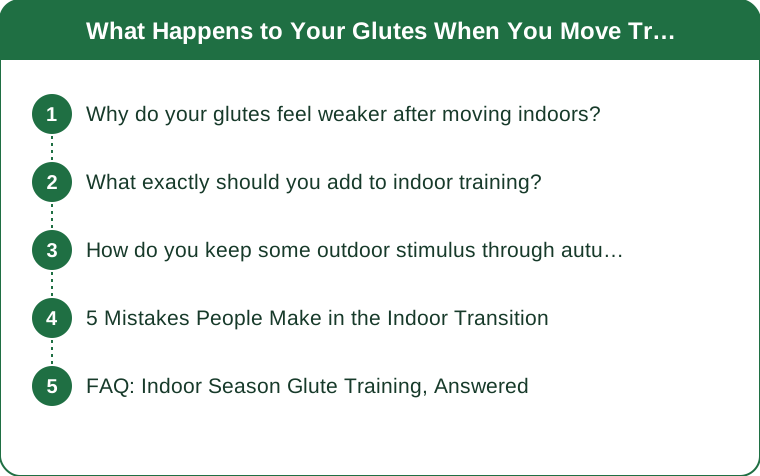
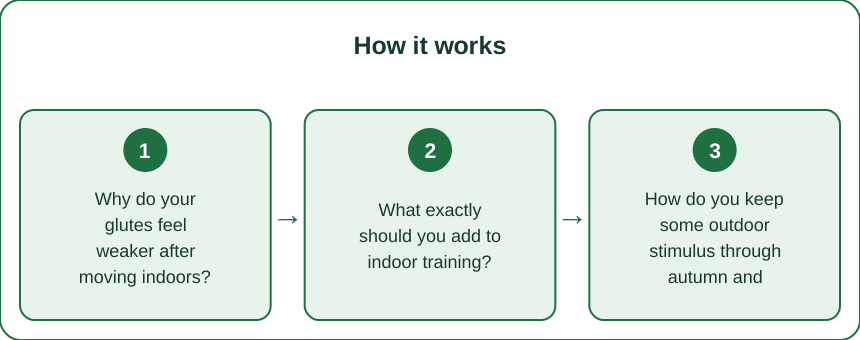
Why do your glutes feel weaker after moving indoors?
Because you lost a stimulus you were never counting as training.
What outdoor movement provided. Walking or running on uneven ground demands continuous small corrections from the gluteus medius and minimus to control the pelvis with every step. Sand, trails, grass, and camber all recruit the lateral hip continuously, and none of that appeared in your training log.
A rough sense of the volume. Someone walking or running outdoors 5 hours a week over a summer accumulates an enormous amount of low-level lateral hip work - not intense, but constant, and stabilising muscles respond well to exactly that pattern.
What indoor training removes:
- Flat, predictable surfaces eliminate the stabilisation demand entirely
- Treadmill running removes camber and surface variation, and the moving belt slightly reduces the propulsive demand
- Machines fix the movement path, which is the whole point of a machine and also removes stabiliser recruitment
- Bilateral exercises let the stronger side compensate, which hides asymmetries rather than fixing them
Why the strength on paper does not drop. Your hip thrust and squat numbers may hold or improve while function declines, because those lifts train the gluteus maximus in the sagittal plane and that is not what you lost. The gluteus medius is the specific casualty.
How it actually presents:
- Hip drop or a feeling of instability on single-leg movements
- Lateral knee or IT band discomfort, which frequently traces back to hip control
- Lower back tightness as the lumbar spine compensates for pelvic control
- Feeling less stable on your first outdoor run of spring, which is when most people notice
The timeline. Stabiliser detraining is fast - noticeable within 3 to 4 weeks of removing the stimulus, and clearly present by 8. The good news is that it comes back roughly as quickly.
What exactly should you add to indoor training?
Single-leg work and frontal-plane loading, both of which get skipped because they are unglamorous.
Single-leg work, which is the priority.
- Bulgarian split squats: 3 sets of 8 to 10 per leg, rear foot elevated 30 to 40cm. The most demanding of the practical options and the one with the best return
- Single-leg Romanian deadlifts: 3 sets of 8 per leg, prioritising control over load. Start with no weight - the balance demand is the training stimulus initially
- Step-ups to a knee-height box: 3 sets of 10 per leg, driving through the heel and controlling the descent. The lowering is where most of the benefit sits and most people drop down
- Single-leg glute bridges: 3 sets of 12 per leg, an accessible starting point if the standing versions are too much
Frontal-plane work, which almost nobody does:
- Lateral band walks: 3 sets of 15 steps each direction, band above the knees, staying in a partial squat. Keep tension the whole set - stepping in and out of tension defeats it
- Copenhagen plank progressions for the adductors, which work in partnership with the lateral hip
- Side-lying hip abduction: 3 sets of 15 per side, slow, with a pause at the top. Basic and genuinely effective
- Lateral step-downs, which train the eccentric control that fails first
Programming it without adding an extra session:
- Two sessions per week is sufficient for stabiliser maintenance
- Put it at the start of the session, not the end. Fatigued stabiliser work has poor quality and quality is the point
- 10 to 15 minutes total is enough. This is not a large time cost
- Keep loads moderate. These muscles respond to control and time under tension, not maximal load
The unstable surface question. Balance pads and wobble boards are less useful than single-leg work on a stable surface for building strength, because the load has to be low for the instability to be manageable. Use them for rehabilitation and variety, not as the main method.

How do you keep some outdoor stimulus through autumn and winter?
By protecting a small amount of it rather than replacing it entirely.
The minimum effective outdoor dose. Two 30-minute walks a week on genuinely uneven ground - trail, park, grass, anything that is not pavement - maintains a meaningful amount of the stabiliser stimulus. This is a low bar and it works.
Making it survive the weather:
- Lunchtime rather than evening, since daylight is the actual constraint. A 20-minute lunch walk in daylight is worth more than a good intention at 6pm in the dark
- Proper footwear and a waterproof, which sounds obvious and is the real determinant of whether it happens in November
- Reframe it as recovery rather than training, which makes it far easier to keep on days you would skip a workout
Indoor substitutes with genuine transfer:
- Treadmill incline walking at 8 to 12 percent, which loads the glutes substantially more than flat running. This is the single best indoor cardio substitution for glute engagement
- Stair climbing, real stairs preferred, which combines hip extension with single-leg loading
- Rowing, which involves powerful hip extension, though in a fixed plane
On the treadmill incline specifically. Walking at 10 percent incline recruits the glutes markedly more than flat walking at the same speed, and it is low-impact enough for daily use. Hold the handrails as little as possible - gripping the rails largely eliminates the benefit by removing the load from the hips.
The reverse-transition warning for spring. The person most likely to get injured in March is the one who trained indoors all winter and goes straight back to trail running at their previous volume. Stabilisers detrain even when the big lifts progress. Rebuild outdoor volume over 3 to 4 weeks rather than resuming where you left off - and if you kept the two weekly walks, this problem largely does not exist.
5 Mistakes People Make in the Indoor Transition
1. Judging glute strength by the hip thrust number. That lift measures sagittal-plane gluteus maximus strength, which is not what indoor training removes. You can add 20kg to your hip thrust while losing the lateral hip control that keeps your knee tracking properly.
2. Replacing outdoor running with treadmill running at the same settings. Flat treadmill running removes camber, surface variation, and some propulsive demand. Add 6 to 10 percent incline and it becomes a genuinely comparable stimulus.
3. Putting stabiliser work at the end of the session. By then quality collapses, and these exercises are entirely about quality of control. Ten good minutes at the start beat twenty poor minutes at the end.
4. Loading single-leg work too heavily too soon. The balance and control demand is the training stimulus in the early weeks. Adding weight before you can control the movement just shifts the work to whatever compensates.
5. Doing lateral band walks with the band too light and the steps too fast. The most commonly butchered exercise in this category. Stay low, keep constant tension, and take deliberate steps - fifteen slow ones beat forty bouncing ones by a wide margin.
The theme is that indoor training defaults to the sagittal plane on stable surfaces, and everything you need to add back is the opposite of that.
FAQ: Indoor Season Glute Training, Answered
Why do my glutes feel weaker indoors when my lifts are going up?
Because indoor training keeps loading the gluteus maximus in one plane while removing the constant lateral stabilisation that uneven outdoor ground provided. The muscle that detrains is the gluteus medius, and it does not show up in your squat or thrust numbers.
How quickly do stabilisers detrain?
Noticeably within 3 to 4 weeks of removing the stimulus, and clearly by 8. They rebuild at a similar rate, so two sessions a week of targeted work is enough to hold the line.
What is the single best indoor exercise to replace outdoor hills?
Incline treadmill walking at 8 to 12 percent, with minimal handrail use. It substantially increases glute recruitment over flat walking and is low-impact enough for regular use.
Do I need unstable surfaces like a balance pad?
No. Single-leg work on stable ground builds more strength, because you can load it properly. Unstable surfaces are useful for rehab and variety, not as the primary method.
How much extra time does this add to my week?
About 20 to 30 minutes total - two sessions of 10 to 15 minutes, placed at the start of workouts you already do. It is a small addition with a disproportionate return.
Why do I get knee or IT band pain in the indoor season?
Often because reduced lateral hip control lets the knee track inward under load. It is frequently a hip problem showing up at the knee. Persistent pain should be assessed by a professional - this is general information, not medical advice.
TL;DR:
- Outdoor summer movement trains the lateral hip constantly, and indoor training removes that overnight
- Your hip thrust number can rise while gluteus medius function declines - they measure different things
- Add single-leg work (Bulgarian split squats, single-leg RDLs, step-ups) and frontal-plane work (band walks, side-lying abduction)
- Two sessions of 10 to 15 minutes weekly, placed at the start of the workout, is enough
- Keep two 30-minute walks on uneven ground, and use 8 to 12 percent treadmill incline as the indoor hill substitute
Indoor training is not the problem. It is just narrower than the summer, and the twenty minutes a week you spend widening it again is what stops March from hurting.
See It in Motion
Seen here: High Waist Bootcut Yoga Pants with Pockets — shop it on bubblelime.com
Keep Reading
This article is for general informational and styling purposes only. Fit, sizing, and product availability may vary.