Why Glute Gains Stall Around Month 6 (And the 3 Things That Actually Restart Progress)
Quick Answer: The 6-month plateau usually means your body has fully adapted to your current rep ranges, exercise selection, and load progression — the fix is a structured change in one of those three variables (not just adding more workouts), typically through periodization, new exercise angles, or a planned deload followed by heavier progressive overload.
This plateau is common enough to have a predictable shape: steady visible progress for the first 3-5 months, then a wall that doesn’t respond to just training harder or more often.

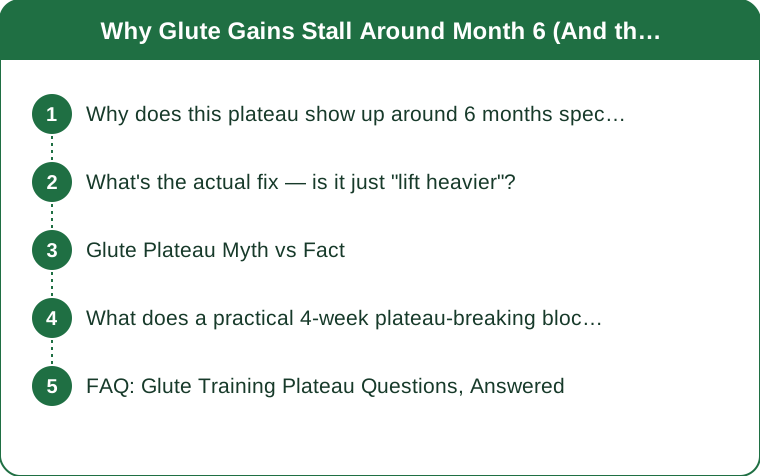
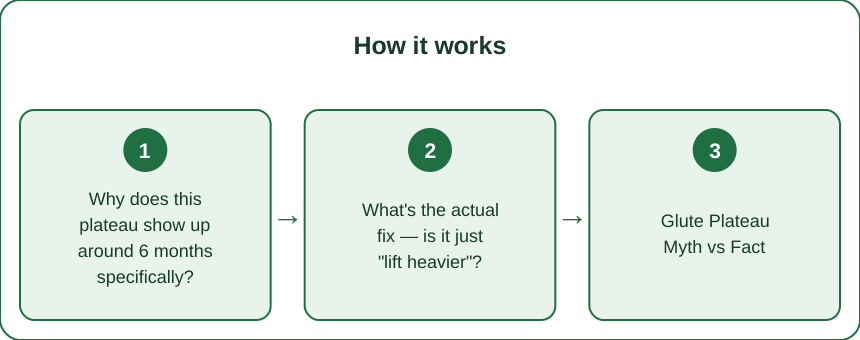
Why does this plateau show up around 6 months specifically?
Early glute training gains come partly from neuromuscular adaptation — your nervous system getting better at recruiting glute muscle fibers you weren’t activating well before — which happens fast, often within the first 8-12 weeks. After that, further growth depends on actual muscle hypertrophy, which requires progressive overload (more weight, more reps, or more total volume over time) in a way that neuromuscular adaptation alone doesn’t need.
Many people plateau because they kept doing the same weight and reps that felt hard in month one but became comfortable by month six — the exercise stopped being a sufficient stimulus for continued growth, even though it still feels like a workout.
What’s the actual fix — is it just “lift heavier”?
Heavier loading is part of it, but it’s one of three levers, and using all three matters more than maxing out just one:
- Load progression — genuinely tracking weights and adding small increments (2.5-5 lbs) every 1-2 weeks on your main lifts (hip thrusts, RDLs, squats)
- Exercise variation — rotating in different angles (single-leg work, cable pull-throughs, banded lateral work) that hit the glute muscles from underused positions
- Volume periodization — cycling between higher-volume phases (more sets, moderate weight) and lower-volume, heavier phases every 4-6 weeks, rather than doing the identical structure indefinitely

Glute Plateau Myth vs Fact
Myth: More glute workouts per week always breaks a plateau. Fact: Beyond a point, more frequency without more intensity or variation just adds fatigue without adding stimulus — 3-4 well-structured sessions with progression outperform 6 stagnant ones.
Myth: A plateau means you need a completely new program. Fact: Often a plateau just means the same core lifts need a genuine deload (a week at lower intensity) followed by a fresh progressive overload push — not throwing out exercises that were working.
Myth: Glute activation exercises alone will restart growth. Fact: Activation work (banded walks, glute bridges) is useful as a warm-up, but it’s not heavy enough to drive continued hypertrophy on its own — it supports the main lifts, it doesn’t replace them.
What does a practical 4-week plateau-breaking block look like?
- Week 1: Deload — same exercises, 60-70% of your usual weight, focus purely on mind-muscle connection and full range of motion
- Week 2-3: Progressive overload push — increase weight or reps on your 2-3 main lifts every session where possible, tracked in a notebook or app
- Week 4: Introduce one new exercise variation per main lift pattern (e.g., swap barbell hip thrust for single-leg hip thrust for two weeks) to hit fibers from a new angle
Most people see the plateau break within this kind of 4-6 week structured block rather than an indefinite continuation of the same routine.
FAQ: Glute Training Plateau Questions, Answered
How do I know if it’s a real plateau or just normal week-to-week fluctuation?
A true plateau is 3-4+ weeks of no measurable progress (same weights, same reps, no visible or strength change) despite consistent training — a single off week is normal variation, not a plateau.
Does diet play a role in a training plateau?
Yes — insufficient protein or being in a significant calorie deficit while trying to build muscle will stall progress regardless of how well-structured the training is, so it’s worth checking that alongside the training variables.
Should I add cardio or cut it during a plateau-breaking phase?
Excessive cardio volume can compete with recovery needed for the harder progressive overload phase — keeping cardio moderate (not eliminated) during a focused strength push tends to work better than either extreme.
TL;DR:
- The 6-month wall usually means neuromuscular gains are exhausted and progressive overload has stalled
- Load progression, exercise variation, and volume periodization are the three real levers — use all three
- A deload week followed by a structured 3-4 week overload push is more effective than training harder indefinitely
- Check protein intake and overall recovery too — training structure isn’t the only variable that can stall
A plateau is information, not a failure — it’s telling you the current stimulus stopped being enough, and a structured 4-6 week adjustment is usually all it takes to move again.
See It in Motion
Seen here: High Waist Printed Bootcut Yoga Pants with Pockets — shop it on bubblelime.com
Keep Reading
This article is for general informational and styling purposes only. Fit, sizing, and product availability may vary.