The Glute Stretches Your Sore Backside Is Asking For
Your lower back has been aching since leg day and you’ve been blaming your mattress.
It’s probably your glutes. They’re the biggest muscles in your body, they attach directly to your pelvis, and when they’re tight they pull on everything upstream — which is why glute soreness so often shows up as back pain and sends people chasing the wrong fix entirely.
Quick Answer: Tight glutes tug on your pelvis and lower back and can irritate the sciatic nerve, which is why leg-day soreness often shows up as back ache. Four stretches cover it: figure-four (30–60 seconds per side, do it daily), pigeon pose when you’re warm, and a seated twist and cross-leg lean you can do at your desk. Best time is post-workout or in the evening, when muscles are already warm.

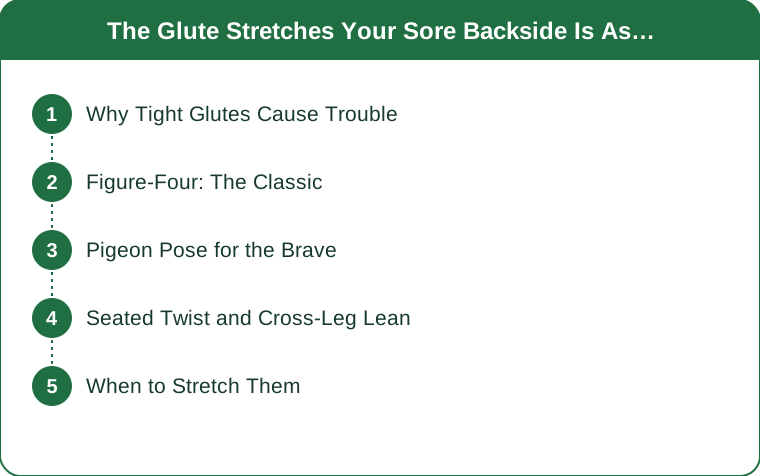
Why Do Tight Glutes Cause Lower Back Pain?
Because of what they’re attached to.
Your glutes anchor directly onto your pelvis. When they’re chronically tight — whether from hard training or from eight hours of sitting on them — they exert a constant pull that can tilt your pelvis out of neutral. Your lumbar spine sits right on top of that pelvis, so it has to compensate for the new angle. That compensation is the ache.
There’s a second route too. The piriformis, a small deep muscle underneath your glute max, sits right next to the sciatic nerve. When it’s tight or irritated, it can press on that nerve and produce discomfort that travels into the glute or down the back of the leg — sensations most people don’t associate with “my butt is tight” at all.
So that mysterious back ache after leg day? Frequently glutes. Stretching them is lower-back care in disguise.
Worth knowing which structures you’re actually targeting, because it changes how you stretch:
- Gluteus maximus — the big one. Responds to hip flexion (knee toward chest).
- Gluteus medius and minimus — on the side of the hip. Respond to crossing the leg over the body.
- Deep external rotators, including the piriformis — respond to the figure-four shape, where the ankle crosses the opposite knee.
That last group is where most of the stubborn tension actually hides, which is why the figure-four is the highest-value stretch on this list.
What Are the Best Glute Stretches?
Figure-four (supine) — the daily one. Lie on your back, knees bent. Cross your right ankle over your left thigh just above the knee. Reach through and pull your left thigh toward your chest. Hold 30–60 seconds per side. Keep your head and shoulders relaxed on the floor and breathe into it rather than bracing.
This is the one to do every day. It targets the deep rotators, it’s low-risk, and you can do it on a carpet before bed with zero setup.
Pigeon pose — the deep one. From all fours, slide your right knee forward toward your right wrist and let your shin angle across in front of you. Extend your left leg straight back. Settle your hips down toward the floor — and put a cushion or folded blanket under your right hip, because almost everyone needs it and unsupported pigeon is where people get overzealous.
Hold 60–90 seconds. Enter and exit slowly, always. This is the deepest glute stretch there is, which also means it’s the easiest one to overdo.
Seated figure-four — the desk one. In a chair, cross your right ankle over your left knee, keep your back straight, and hinge forward from the hips. Hold 30 seconds per side. This is genuinely effective and you can do it in an office chair without anyone noticing.
Seated twist and cross-leg lean. Cross one leg over the other, hug the top knee, and rotate gently toward that side. Then release the twist and lean forward over the crossed leg. Your glutes don’t care where the relief comes from.

When Should You Stretch Your Glutes?
Post-workout and in the evening are prime time. Muscles are warm, they lengthen more easily, and there’s no downside to being relaxed afterward.
After leg day specifically, two minutes of glute stretching — figure-four both sides, seated twist both sides — noticeably softens how the next day feels for a lot of people. It’s a very small time investment against a fairly annoying problem.
Before a workout, keep it brief. Long static holds immediately before heavy lifting aren’t ideal — research generally shows prolonged static stretching can temporarily reduce force output. Save the 60-second holds for after. Beforehand, do glute activation instead: bridges, banded walks, a few bodyweight squats.
On desk days, set a reminder. Sitting keeps your glutes in a lengthened-but-inactive position for hours, and the seated figure-four takes 60 seconds. Once mid-morning and once mid-afternoon does more than one long evening session.
What Nobody Tells You About Glute Stretching
Tight often means weak, not short. This is the one that changes people’s approach. A glute that feels perpetually tight is frequently one that’s underworked — it’s not shortened, it’s overworking to compensate for something else. If you stretch daily for a month with no lasting improvement, the missing ingredient is usually strengthening: bridges, hip thrusts, side-lying abductions. Stretch for relief, strengthen for the actual fix.
Both sides, even if only one hurts. Asymmetry is common, and stretching only the sore side tends to widen the gap. Do both, always.
Don’t hold your breath. Almost everyone unconsciously breath-holds in a deep stretch, which increases muscular tension — the exact opposite of the goal. If you can’t breathe normally in a position, you’re too deep by about 20%.
Sharp or radiating is a stop signal. A good glute stretch feels like a strong, dull pull in the meat of the muscle. Sharp pain, or anything shooting down the back of your leg into the calf or foot, is not a stretch to push through. Back off. If that sensation persists — or if you have numbness, tingling, or weakness in the leg — see a physio or physician rather than stretching harder. Sciatic symptoms have several possible causes and self-treating the wrong one wastes weeks.
Consistency beats intensity by a mile. Sixty seconds of figure-four daily outperforms a punishing twenty-minute session once a week. This is a tissue-adaptation thing, and tissue responds to frequency.
FAQ
How long should you hold a glute stretch?
Roughly 30–60 seconds per side for figure-four and seated stretches, and 60–90 seconds for pigeon. Shorter than about 20 seconds and you’re mostly getting a reflexive response rather than a real lengthening effect. Two to three rounds per side is plenty for one session.
Can you stretch your glutes every day?
Yes — daily gentle stretching is fine and generally more effective than occasional intense sessions. Keep deep positions like pigeon for days when you’re already warm, and use the figure-four as the everyday default. If something is still genuinely sore from training, stretch gently rather than aggressively.
Why do my glutes feel tight even though I stretch them?
Usually because they’re weak rather than short. A glute that’s underworked can feel chronically tight because it’s straining to keep up, and stretching alone won’t resolve that. Adding glute bridges, hip thrusts, or side-lying leg raises two or three times a week is the piece most people are missing.
TL;DR:
- Tight glutes pull on your pelvis and lower back and can irritate the sciatic nerve — that leg-day back ache is often glutes.
- Figure-four, 30–60s per side, daily. The single highest-value stretch; targets the deep rotators where tension hides.
- Pigeon with a cushion under the hip, 60–90s, only when warm. Enter and exit slowly.
- Seated figure-four at your desk, once mid-morning and once mid-afternoon on sitting days.
- Stretch after training, not before heavy lifting. Use activation work beforehand instead.
- Chronically tight usually means weak. Stretch for relief, strengthen for the fix.
- Sharp or radiating pain down the leg = stop and get it looked at, don’t stretch harder.
See It in Motion
Seen here: High Waist Yoga Leggings with Inner Pocket — shop it on bubblelime.com
Keep Reading
This article is for general informational and styling purposes only. Fit, sizing, and product availability may vary.