Glute Soreness Is Not a Measure of a Good Session
Quick Answer: Soreness tracks novelty and mechanical stretch under load — not muscle growth. You get sore from new exercises, long eccentric ranges and unfamiliar volume, all of which fade as you adapt. Progress is measured by load, reps and quality over weeks, not by how much it hurts to sit down two days later. Chasing soreness reliably produces worse training.
The cruelest part is that the sorest sessions are usually the ones early in a program, when you are building the least.

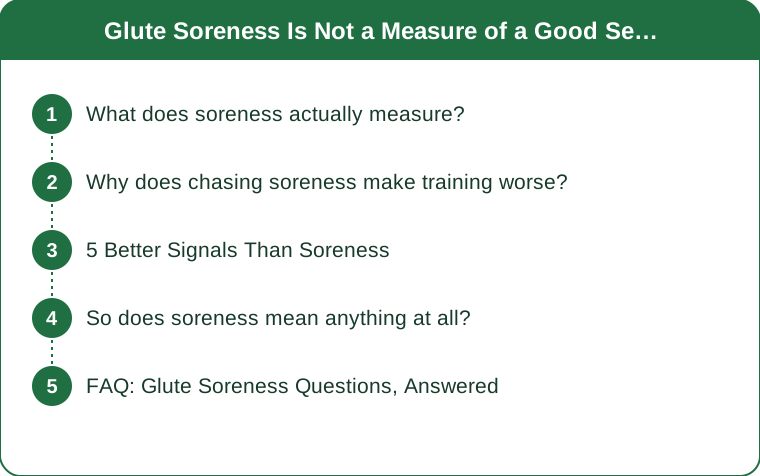
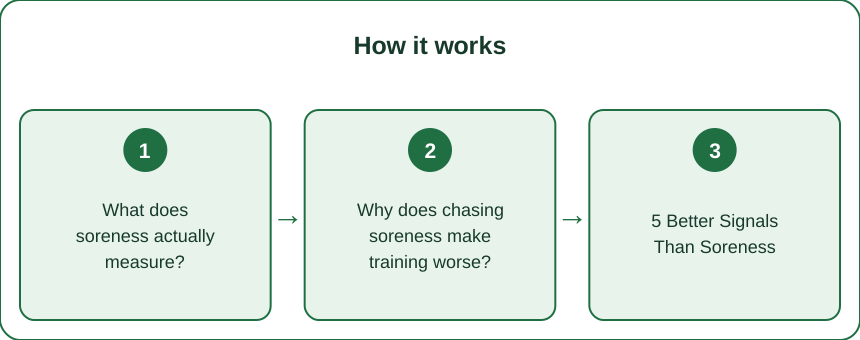
What does soreness actually measure?
Three things, none of which is hypertrophy.
Novelty. The first session of any new movement produces disproportionate soreness, and the same session repeated a week later produces much less — the repeated bout effect. Nothing about your muscle got weaker; your body adapted its response. A movement you have done for six months will basically never make you sore again, even when you are progressing well on it.
Eccentric loading at long muscle lengths. Lowering under load with the muscle stretched is the single biggest driver of soreness. For glutes this means deep squats, deficit lunges, and Bulgarian split squats — which is why those leave you wrecked while hip thrusts, which load the glute in its shortened position, often produce almost none. A hip thrust session that produces zero soreness can absolutely be the more effective glute session.
Volume relative to what you are used to. A jump from 9 to 20 sets in a week will make you sore regardless of exercise choice. That is a recovery debt, not an achievement.
What it does not track: mechanical tension accumulated across working sets, which is the primary driver of hypertrophy. There is no consistent relationship between how sore a muscle gets and how much it grows.
Why does chasing soreness make training worse?
Because the fastest way to get sore is to stop doing what works.
It pushes you toward constant exercise switching. If soreness is the scorecard, you have to keep changing movements to keep scoring — and progressive overload requires repeating a movement long enough to add load to it. People who rotate exercises every session are perpetually sore and perpetually stuck at the same weights.
It biases toward long-range movements at the expense of everything else. Deep lunges make you sore, so they get all the volume. Hip thrusts, back extensions and abductions do not, so they get dropped — even though those load the glutes in ranges that deep squats barely reach.
It compromises frequency. Training glutes twice a week beats once for most people, but you cannot train a muscle group twice weekly if every session leaves you unable to walk. Chasing soreness caps your frequency at whatever your recovery from destruction allows.
It masks actual fatigue. Soreness feels like feedback, so people use it instead of tracking. Meanwhile the numbers in the log have not moved in two months and nobody noticed, because every session felt like it worked.

5 Better Signals Than Soreness
1. Load and reps in the log. The most boring and most reliable. Same movement, same rep range, more weight or more reps over four to six weeks. If your hip thrust went from 60kg for 8 to 75kg for 8 in six weeks, you progressed — regardless of how it felt afterward.
2. Reps in reserve consistency. Are you finishing sets with a genuine two to three reps left, or are you guessing? Training close enough to failure matters far more than exercise selection. If you are consistently stopping at 5 or 6 reps in reserve, that is your actual problem.
3. The mind-muscle connection during the set. Not mystical — it is a real indicator of whether the glutes are doing the work or the quads and lower back are taking over. If you feel the movement in your lower back on every set, that is more informative than any amount of next-day soreness.
4. Rep quality at the end of a set. If reps 6 through 8 look like reps 1 through 3, you have control. If range of motion collapses and the bar path changes, the load is too heavy for productive work regardless of how it feels tomorrow.
5. Weekly volume tracking. Total hard sets for glutes per week. Somewhere in the range of 10 to 20 hard sets per week works for most people, and knowing your number lets you adjust deliberately instead of by feel.
The uncomfortable implication: four of these five require writing things down.
So does soreness mean anything at all?
Yes — it is useful as a warning signal rather than a scorecard.
Soreness that lasts more than three days suggests you overshot volume or intensity relative to current recovery capacity. Useful information, and the correct response is to reduce, not to feel accomplished.
Soreness in an unexpected place is worth attention. Glute work that consistently leaves your lower back sore rather than your glutes is a technique signal — usually excessive lumbar extension at the top of a hip thrust or a bridge.
Sudden soreness from a familiar session can indicate under-recovery: poor sleep, low intake, or accumulated fatigue from elsewhere.
Complete absence of soreness plus stalled numbers is the actual red flag. Not because you need soreness, but because it can indicate you are training far from failure and not progressing on either measure.
A reasonable frame: mild soreness for a day is unremarkable. Severe soreness for three-plus days means back off. No soreness with rising numbers means it is working.
FAQ: Glute Soreness Questions, Answered
Should I train glutes when they are still sore?
Mild soreness is fine — light movement often reduces it. Significant soreness that alters your movement is worth waiting out, because compensating around sore glutes trains something other than glutes. If you are consistently too sore to train twice a week, reduce per-session volume and add the second session.
Why do hip thrusts never make me sore even at heavy loads?
Because peak tension occurs at the shortened position rather than the stretched one, and shortened-position loading produces very little muscle damage. This is a feature, not a defect — it lets you accumulate high-quality volume with low recovery cost, and it is exactly why hip thrusts pair well with a stretch-loaded movement like a deficit lunge.
Is foam rolling or stretching worth it for soreness?
Both can reduce the perception of soreness modestly and neither meaningfully speeds recovery of function. If it makes you feel better and you enjoy it, it is fine. It is not doing what people think it is doing.
TL;DR:
- Soreness tracks novelty, long-range eccentric loading and volume jumps — not growth.
- Chasing it pushes you toward constant exercise switching, which blocks progressive overload.
- Track load, reps, reps in reserve, rep quality and weekly hard sets instead.
- Hip thrusts producing no soreness is expected and does not mean they are not working.
- Use soreness as a warning about overshooting, not as a scorecard.
The sessions that build the most are usually the ones that felt unremarkable and moved the numbers. Write them down and let the soreness stop being the point.
See It in Motion
Seen here: High Waist Bootcut Yoga Pants with Pockets — shop it on bubblelime.com
Keep Reading
This article is for general informational and styling purposes only. Fit, sizing, and product availability may vary.