Why Glute Bridges Stopped Doing Anything (And What to Do Instead)
Quick Answer: Glute bridges stop working once your glutes adapt to bodyweight resistance, usually within 4-6 weeks of consistent training — adding load (a band, a plate, or progressing to single-leg and hip thrust variations) restarts the stimulus.
Three months ago, 3 sets of bridges left your glutes shaking. Now you finish a set and barely notice you did anything. That’s not a sign bridges are useless — it’s a sign your body adapted faster than your program did.

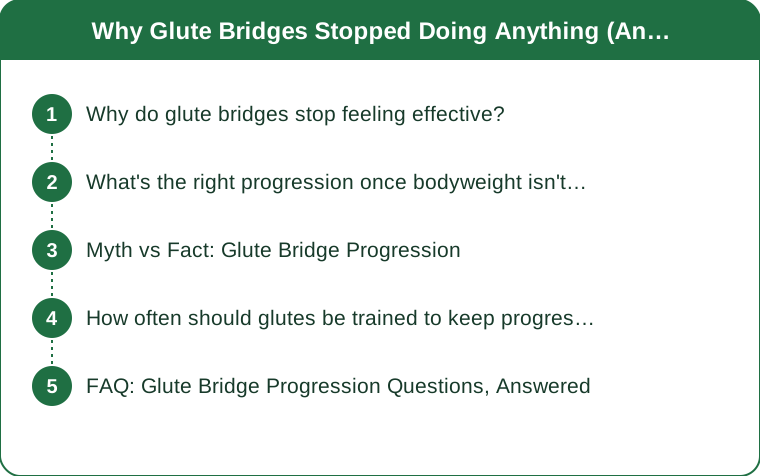
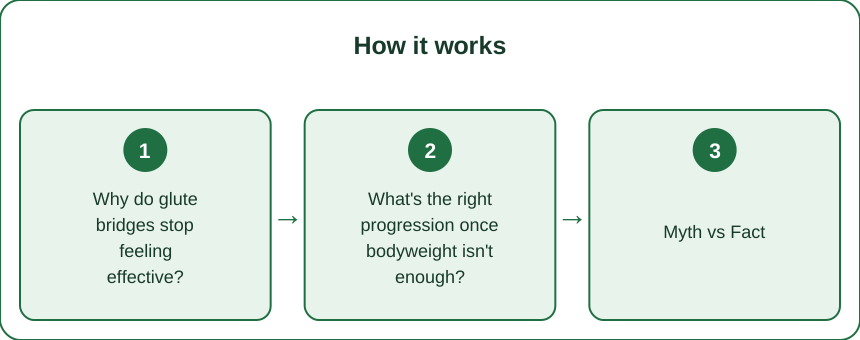
Why do glute bridges stop feeling effective?
Because muscles adapt to a fixed resistance level within weeks, and bodyweight alone is a fixed, finite stimulus. Once your glutes can comfortably produce the force needed to lift your bodyweight through that range of motion, the exercise stops providing enough of a challenge to drive further strength or growth.
This typically happens 4-6 weeks into consistent bodyweight bridge training — earlier for people who started with some existing glute strength, later for true beginners.
What’s the right progression once bodyweight isn’t enough?
Add external load before switching exercises entirely. The simplest first step is a resistance band around the thighs (adds constant tension) or a weight plate/dumbbell across the hips (adds direct load).
After that, progress to single-leg glute bridges (roughly doubles the load on each side) and eventually barbell hip thrusts, which allow much heavier loading than a floor bridge ever can — hip thrusts are widely considered the more scalable long-term glute exercise for exactly this reason.

Myth vs Fact: Glute Bridge Progression
Myth: More reps is the same as more load. Fact: Past a certain rep range (usually 20-25+), adding reps mostly builds muscular endurance, not strength or size — a heavier load at 8-15 reps drives more growth than 40 reps of an easy bodyweight bridge.
Myth: If it doesn’t burn, it’s not working. Fact: A workout that feels easy because your muscles have genuinely adapted is a sign of progress, not failure — it’s simply the cue to progress the exercise, not proof the exercise was pointless.
How often should glutes be trained to keep progressing?
2-3 times per week, with at least one rest day between sessions targeting the same movement pattern, allows for both adaptation and recovery. Training glutes daily without load progression is a common reason people plateau — more frequency without more resistance just reinforces the current adaptation ceiling.
FAQ: Glute Bridge Progression Questions, Answered
When should I switch from bridges to hip thrusts?
Once a banded or weighted bridge feels manageable for 15+ reps, hip thrusts (which use a bench for a longer range of motion) are the natural next step.
Do glute bridges build the same muscle as squats?
Mostly the same primary muscle (glutes) but through a different movement pattern — bridges emphasize hip extension in isolation, while squats combine it with knee-dominant work, so they complement rather than replace each other.
Is it normal for one side to feel weaker during bridges?
Yes, mild asymmetry is common — if it’s pronounced, single-leg bridge work on the weaker side specifically helps close the gap over several weeks.
TL;DR:
- Glute bridges plateau in 4-6 weeks once your body adapts to bodyweight resistance
- Add a band, weight plate, or progress to single-leg bridges and hip thrusts
- An easy-feeling bridge is a progress signal, not a failure signal
- Train 2-3x weekly with real load progression, not just added reps
Swap in a band or plate this week and the burn comes right back.
See It in Motion
Seen here: Bootcut Yoga Pants with Side Pockets — shop it on bubblelime.com
Keep Reading
This article is for general informational and styling purposes only. Fit, sizing, and product availability may vary.